Local SEO and Google AI Mode: why google.com became its most cited domain
Google AI Mode cited google.com more than any other domain in May and June 2026. What that does and doesn't tell local SEO clients, and how we check it.
Multi-location businesses keep asking us some version of the same question: "If Google's AI Mode mostly cites Google, is our local SEO work already doing the job?" It usually comes from a chart they have seen. In May 2026, google.com became the most cited domain in Google AI Mode for the first time. By June it was cited more than YouTube and Reddit combined.
Our answer is "partly, and we can check exactly how much." This post explains the data, why we are careful about what it means, and the steps we take to see what google.com citations look like for a local business's own prompts.
What the two reports show
Promptwatch publishes a monthly citation share report for Google AI Mode, ranking the domains AI Mode cites by their share of all its citations.
In the May 2026 report (May 1 to 31, 2026), google.com reached 4.24% and took first place, ahead of YouTube at 3.42% and Reddit at 2.36%. The report puts Google-owned domains at roughly 7.7% combined. The month before, google.com had been at 0.71%, so the move from April to May was roughly sixfold.
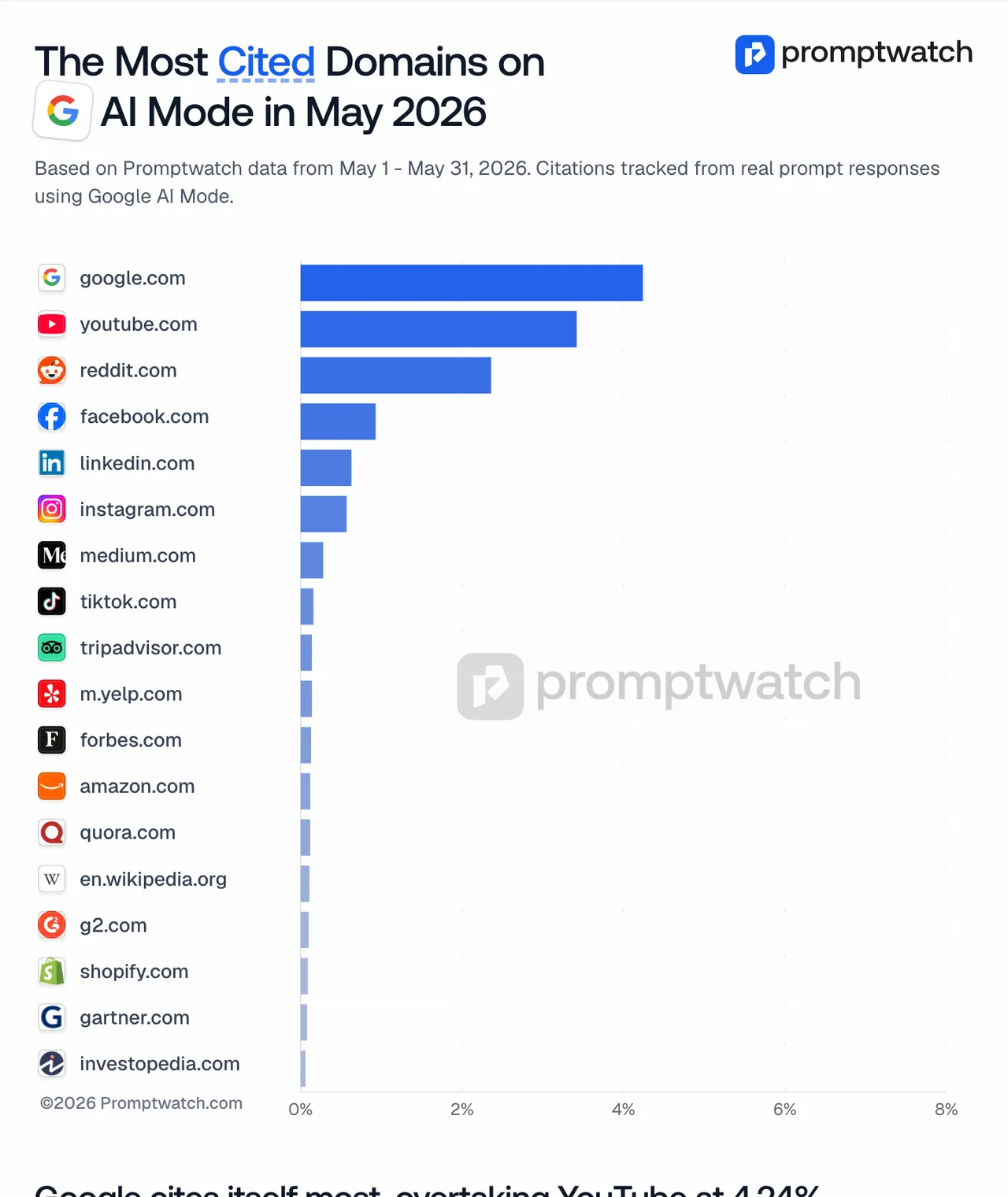 Promptwatch's "The Most Cited Domains on AI Mode in May 2026" chart, captured November 14, 2026.
The June 2026 report covers June 1 to 27 only, so its figures are month-to-date. In that window google.com reached 7.31%, more than YouTube (2.88%) and Reddit (2.52%) together, and Google-owned domains passed 10%. The page itself cautions that June is month-to-date and the dip it saw for YouTube "may deepen or reverse." The same caution applies to google.com's jump.
For context on how unusual that is: in the February 2026 report (Feb 1 to 28, 2026), "Google's own properties" were at 0.79%, and no domain reached even 2%.
What we can't tell from it
The reports don't say which google.com pages AI Mode cites. That is the single most important limit here, and it is easy to skip past.
A local business owner hears "google.com" and thinks of their Business Profile, their Maps listing, and their reviews. That might be part of it. It might also be search result pages, Google's own help or product pages, or other Google surfaces entirely. The reports group everything on the domain into one number. Our read is that local and place-related answers probably account for some of it, because AI Mode answers to "near me" questions often lean on listing data. But that is our interpretation, and we tell clients so plainly.
The second limit is scope. These are population figures across all the prompts Promptwatch tracks. They don't say how much of a dentist's, a plumber's, or a car dealer's AI Mode visibility runs through google.com. That depends on the prompts and the location.
So we don't tell local clients that their Business Profile now "ranks in AI Mode." We tell them google.com is the fastest-growing source in AI Mode, and then we go and look at their own answers.
How we check it for a local client
The check has three parts.
Track the prompts where the client actually competes
Local AI visibility only makes sense at the level of a place. "Best emergency plumber" asked from Rotterdam and from Utrecht can name different businesses. In Promptwatch, the platform we run client programs on, monitors can be set to a state or city on the Business plan ($579/mo), on every agency plan, and on Enterprise. Business, Agency Scale, and Enterprise also offer local GEO/SEO targeting, which pins a monitor to exact coordinates with a radius between 20 m and 5 km.
One detail matters for this topic. ChatGPT uses the exact pinned point. Google AI Overviews and Google AI Mode use the nearest named area to the pin, and other models use the monitor's country, state, or city. So for AI Mode we set the pin at the location and expect answers for the surrounding named area, not for the exact street corner. Promptwatch's November 6 changelog reports a fix for this: in their test, pinned AI Mode answers landed in the pinned metro 46 of 48 times, up from 32.
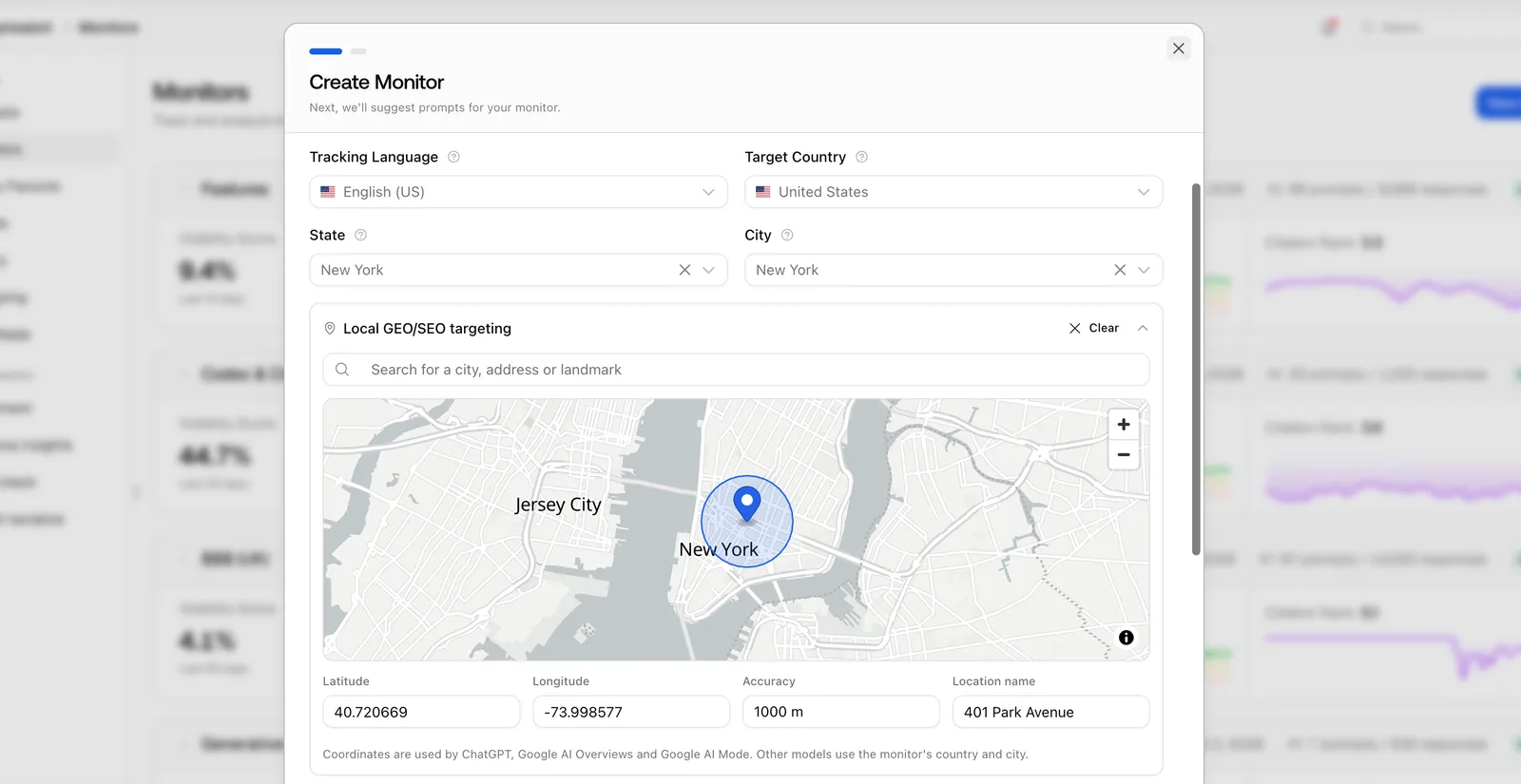 Promptwatch's changelog entry for local GEO/SEO coordinate targeting, captured November 6, 2026. The location and values in the dialog are an example.
Our setup process for new local clients is in how we set up local GEO tracking for a new client.
Open the cited URLs, not just the domains
Once AI Mode answers come in, we open the citation analytics for those monitors. All Citations and URL Positions list the exact URLs, so we can see which google.com pages were cited for this client's prompts and where they sat in the source list. This is the step that turns a vague population trend into something concrete. If the cited google.com URLs are business listings, the Business Profile is directly in play. If they are something else, we know the Business Profile isn't the lever for that prompt, whatever the population chart suggests.
Compare with competitors at the same location
We then look at which competitors AI Mode names for the same prompts and what it cites for them. If a rival with weaker classic rankings keeps being named, the cited sources usually explain why: a review site, a directory, a news article, a better listing. That comparison tells us what to fix first.
What local SEO work this connects to
Once we know what AI Mode cites for the client, the work is mostly familiar local SEO, prioritized by what we found.
Business Profile completeness comes first when listings appear in the cited URLs. That means accurate categories, hours, services, attributes, photos, and a description that says plainly what the business does and where. Review flow and replies matter too, because AI answers to "best" prompts often summarize reputation.
Consistent name, address, and phone details across directories still matter. The AI Mode reports show some review and travel sites in the long tail. Yelp went from 0.37% in February to 0.15% in March (March report, Mar 1 to 31, 2026), and Tripadvisor from 0.22% in March to 0.17% in April (April report, Apr 1 to 30, 2026). Those are small shares that moved quickly, so we keep directory work proportional rather than treating any single site as essential.
Location pages on the client's own site still carry the detail a listing can't: service areas, specific services per location, staff, parking, local proof. When AI Mode cites the client's site rather than a Google surface, it is usually one of these pages. We make sure each location has one, with unique content, and that it is linked from the main navigation.
Local schema and clean structured data help Google parse the business correctly across its surfaces. That's ordinary good practice, and it costs little.
We report progress location by location, not as one average, for the reason covered in how we report local AI visibility to clients: an average hides the locations that are invisible.
What we tell the client
google.com is now the biggest single source in AI Mode in Promptwatch's data, with the June figure still month-to-date. That makes Google-facing local work worth more, not less. But "Google cites Google" doesn't tell anyone which pages, and a plan built on that guess can miss the actual sources for a client's prompts.
So the honest answer to "is our local SEO already doing the job?" is: we'll know after we've seen your own AI Mode answers for each location, with their cited URLs. That takes a few weeks of tracking, not a single search. If you run a local business and want to try it, the 7-day free trial covers the setup, and the location features above start on Business. The rest of the monthly reports are on the Promptwatch data index.