Dealer clients: marketplaces vs dealer pages in ChatGPT answers
Promptwatch's August 2026 automotive report shows ChatGPT citing marketplaces far more than car brands or dealers. How we plan dealer client work around that.
27.27%. That is the share of ChatGPT's automotive citations that went to marketplaces, listings, and research and review sites in August 2026, according to Promptwatch's automotive citation share report (August 1 to 31, 2026, based on real automotive prompts run through ChatGPT). Manufacturer sites got 7.92%. Dealerships were folded into a leftover group with community, news, and service and finance sites that came to 2.12% combined.
If you run marketing for a dealer group, that last number is the one that stings. This post covers how we read the report for dealer clients, what we plan differently because of it, and how we measure whether the plan works.
What the report actually says
The top of the chart is dominated by places people go to shop and research cars. In the August 2026 report (August 1 to 31, 2026), Autotrader.com is first at 5%, Cars.com second at 4.6%, and the report says seven of the top eight domains are marketplaces or automotive research and review sites. The chart shows carfax.com, kbb.com, cargurus.com, edmunds.com, and dealerrater.com in that upper group.
Chevrolet.com is the exception. In the same August 2026 window it is the only manufacturer site in the top eight, at fourth place with 2.62%. Reddit sits ninth at 1.34% (automotive report).
Further down, one dealership makes the chart of the top 31 domains for August 2026: birchwoodgroup.co.uk, at 0.28% (automotive report). It is the only dealer site there.
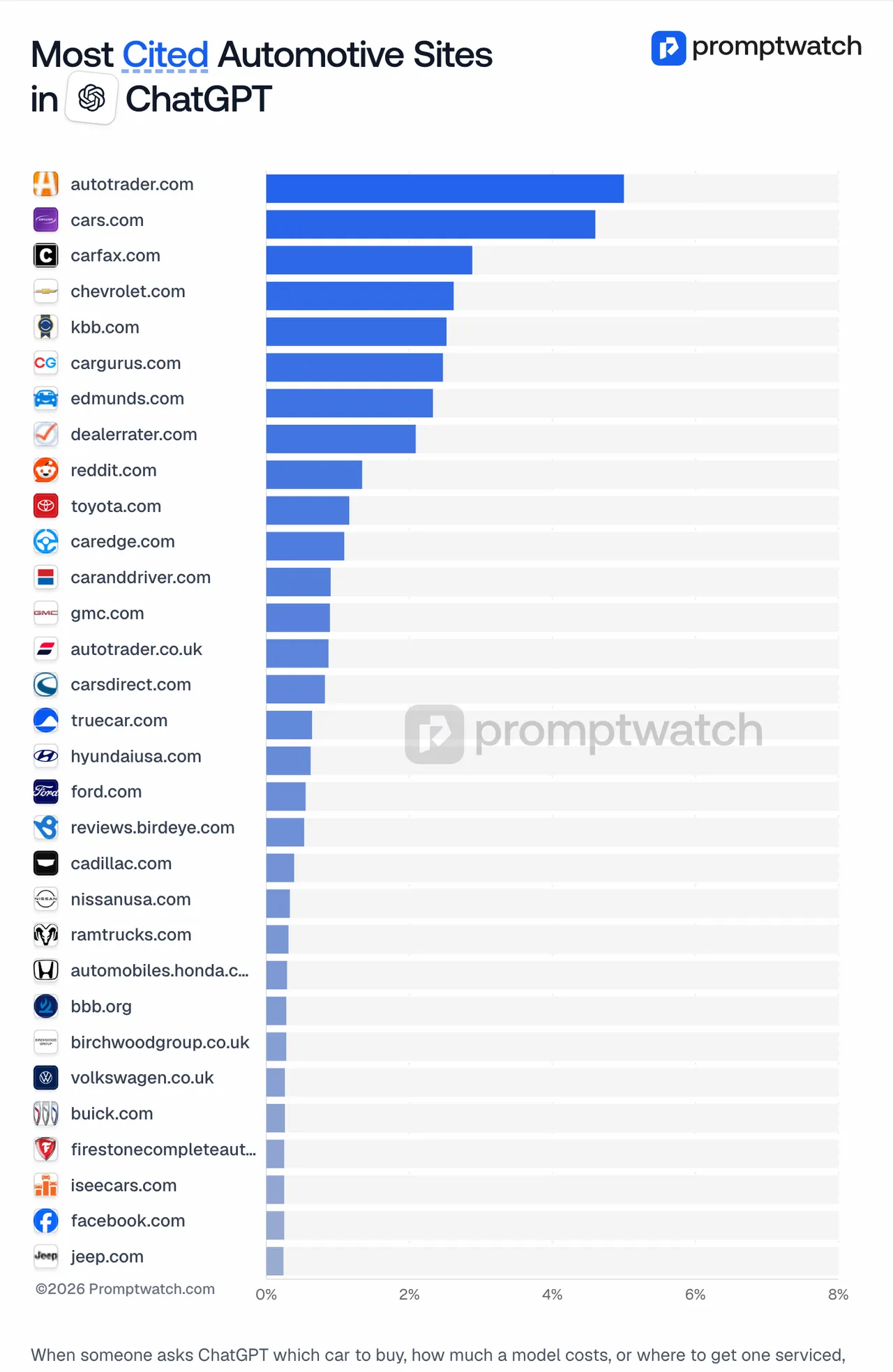 Promptwatch's "Most Cited Automotive Sites in ChatGPT" chart from the August 2026 automotive report, captured November 14, 2026.
By source type, the August 2026 report splits the month's citations as marketplaces and listings at 14.65%, reviews and research at 12.62%, and manufacturer sites at 7.92%. Its tips name DealerRater, Birdeye, and BBB as review profiles worth keeping in shape, without giving percentages for them.
Two caveats before we use any of this. First, the shares are of all automotive citations, and the chart only shows the top 31 domains, so most citations sit with sites outside it. Second, unlike Promptwatch's October industry reports, this one doesn't say it is limited to organic prompts. We don't assume either way.
How we read it from a dealer's seat
A dealer isn't really competing with Autotrader. A dealer is competing with the other dealers in its market, and the marketplaces are the stage where much of that competition happens. When ChatGPT answers "where can I buy a used RAV4 near me" or "which dealers in my area have good service reviews," the answer often leans on listings and review pages, and the dealers named are frequently the ones whose inventory and reputation show up well there.
That is our interpretation. The report shows where citations landed, not how ChatGPT picked a dealer to name. But it fits what we see when we read individual answers, and it changes the order of work.
The report also has a hopeful reading. A single dealer group site reaching the top 31 shows that a dealer's own pages can earn citations at scale. We don't know why birchwoodgroup.co.uk in particular made it; the report doesn't say. We treat it as proof that it's possible, not as a template.
What we plan for dealer clients
We split dealer work into four streams, roughly in this order.
Listings first
Inventory accuracy on the marketplaces comes first, because that's where the largest share of citations sits. We audit how the client's stock appears on the marketplaces they pay for: correct trims, prices, mileage, photos, and the dealer name spelled the same way everywhere. Stale or mismatched listings are the cheapest problem to fix and probably the most common.
Reviews second
Reviews and research sites held 12.62% of automotive citations in August 2026, per the automotive report. For a dealer, the review side matters most. We set up a steady review request flow after sales and service visits, and we reply to reviews on the profiles that matter in the client's market. The report names DealerRater, Birdeye, and BBB. We check which of those, plus any others, actually get cited for the client's own prompts before deciding where to focus.
Model and inventory pages on the dealer site
Manufacturer sites earned 7.92% in the August 2026 window of the automotive report, and Chevrolet.com shows a brand site can rank near the top. A dealer site can't replace the manufacturer, but it can be the local version of it. We make sure every model the dealer sells has a stable page with specs, trims, and pricing context, linked to live inventory. Stable matters: pages that disappear when a vehicle sells don't build up citations. We keep model pages permanent and let inventory listings come and go underneath.
Local pages and service content
This is where the dealer's own site has no competition from marketplaces. Service department pages, finance explainers, trade-in pages, and location pages with real details (hours, address, which brands are serviced, directions) answer local questions that listings don't. Classic local SEO carries over directly: a complete Business Profile, consistent contact details across directories, local schema.
For multi-rooftop groups, each location gets its own page and its own review flow, because AI answers are local and an average across rooftops hides the weak ones. Our car dealership tool post goes deeper on the local tracking side.
How we measure it
We run dealer programs on Promptwatch, the platform we run all client programs on. The measurement follows the same four streams.
We start with prompt tracking. We build a prompt set from what car shoppers actually ask: model comparisons, "best dealer for X near me," service questions, financing questions. Because dealer questions are local, monitors are set to the dealer's state or city. That needs the Business plan ($579/mo) on brand plans, or any agency plan, or Enterprise. Groups that need a pin per rooftop can use coordinate targeting on Business, Agency Scale, or Enterprise.
 Promptwatch's prompt tracking feature page, captured November 8, 2026. The brands and numbers in the dashboard preview are example data.
Then citations. The citation analytics show which marketplace, review, and dealer pages ChatGPT cites for the client's prompts. Citation Trends classifies sources by type, including a Directory type for listing and review sites, which makes it easy to see whether the client's answers lean on listings, reviews, manufacturer pages, or the dealer's own site. Offsite mentions show where the dealer is named on third-party pages without a link.
Page Tracker follows specific URLs. We add the client's main model pages and location pages and watch whether any tracked response cites them, and we add a competitor's page when it keeps showing up. For brand-plan clients on Professional and up, Agent Analytics shows whether AI crawlers can reach those pages at all, which rules out an access problem before we blame the content.
Finally, Visitor Analytics shows AI-referred visits and conversions on the dealer site, so we can tell the sales manager whether any of this produced leads, not just citations.
We don't promise that a dealer will be named in a given answer. We can say which sources ChatGPT uses for the client's market, fix what the client controls, and show over a few months whether the share of answers naming the dealer moved.
Where to start
If you want a quick picture before committing to anything, run the free AI Visibility Report on your dealer site. It scans ChatGPT, Gemini, and Perplexity and checks crawler access. Then compare what it finds with the automotive report above, and with the other industry reports on the Promptwatch data index.