How AI perceives local businesses, and what we change first
How AI engines describe local businesses from listings, reviews, and local sources, how we monitor it by city, and the three fixes we make before anything else.
Ask an AI assistant for "an emergency plumber in Haarlem who works weekends" and you get a short list with a sentence or two about each business. One is "family-run with fast response times". Another "has mixed reviews about pricing". A third is described as covering a service area it stopped serving last year. For a local business, those sentences are the whole pitch. There's no website visit, no comparison of three tabs. The description is the first impression, and sometimes the only one.
That's what we mean by AI perception for local businesses: not whether the business gets named, but how it's described when it does. Opening hours, service area, specialties, price level, how reliable people say it is. This post covers where AI gets those descriptions, how we monitor them by location, and the order we fix things in for local clients.
Where the description comes from
AI models don't hold opinions about a plumber. They summarize what they read. Promptwatch's Academy puts it plainly on the Sentiment tracking page: a negative response almost always traces back to a specific review page, forum thread, or outdated article, and that source is what you can act on.
For local businesses, the sources tend to be a familiar mix to anyone who has done local SEO: directory and listing pages, review profiles, local news coverage, neighborhood forums, and the business's own site. What changes is how the engine uses them. It doesn't send the reader to the listing. It reads the listing and writes a sentence.
You can see which sources fed a specific answer. When a live-search engine responds, Promptwatch records every source it used and groups them by how the model used them.
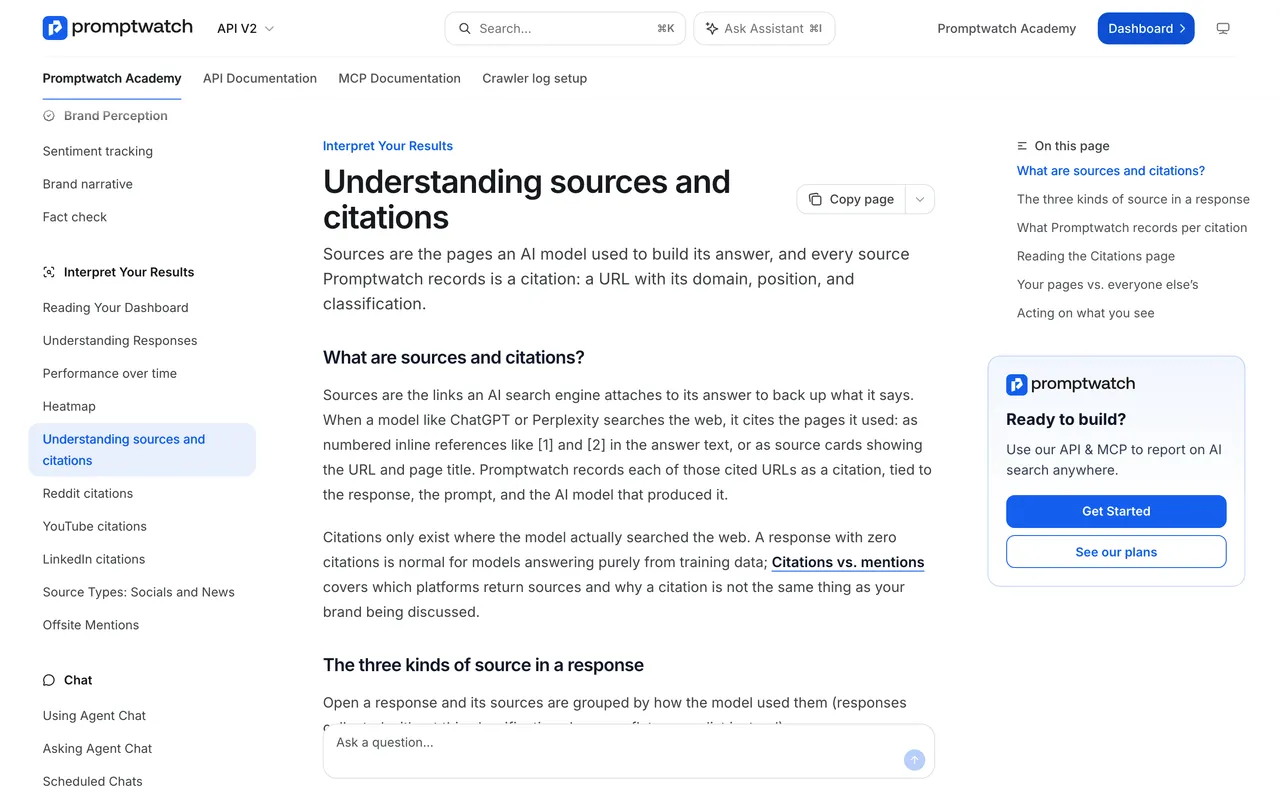 Promptwatch Academy's Understanding sources and citations page, captured November 14, 2026.
The Academy describes three tiers in a response. Inline citations back specific claims in the text and carry the most weight. Footnotes are cited but not tied to a sentence. Search results are pages the engine browsed but didn't cite. For a local client, the inline tier is where we look first: if the sentence "has mixed reviews about pricing" carries an inline citation to a particular review profile, we know exactly which page shaped it.
Each citation also carries a source type. Since October, Promptwatch's Citation Trends includes a Directory type for listing, review, and marketplace sites, which makes it simple to filter down to the listings feeding a local client's answers. We wrote up the method in how we find which local directories AI cites.
Monitoring by city, and by exact location
Country-level tracking tells a local business almost nothing. An answer about "plumbers near me" asked from Amsterdam has nothing to do with the same question asked from Rotterdam. So local programs need location-specific monitors.
In Promptwatch, state and city tracking is available on the Business plan ($579 a month), on every agency plan, and on Enterprise. For tighter local work, Local GEO/SEO targeting pins a monitor to exact coordinates: you search for a place or drop a pin and set a radius from 20 meters to 5 kilometers.
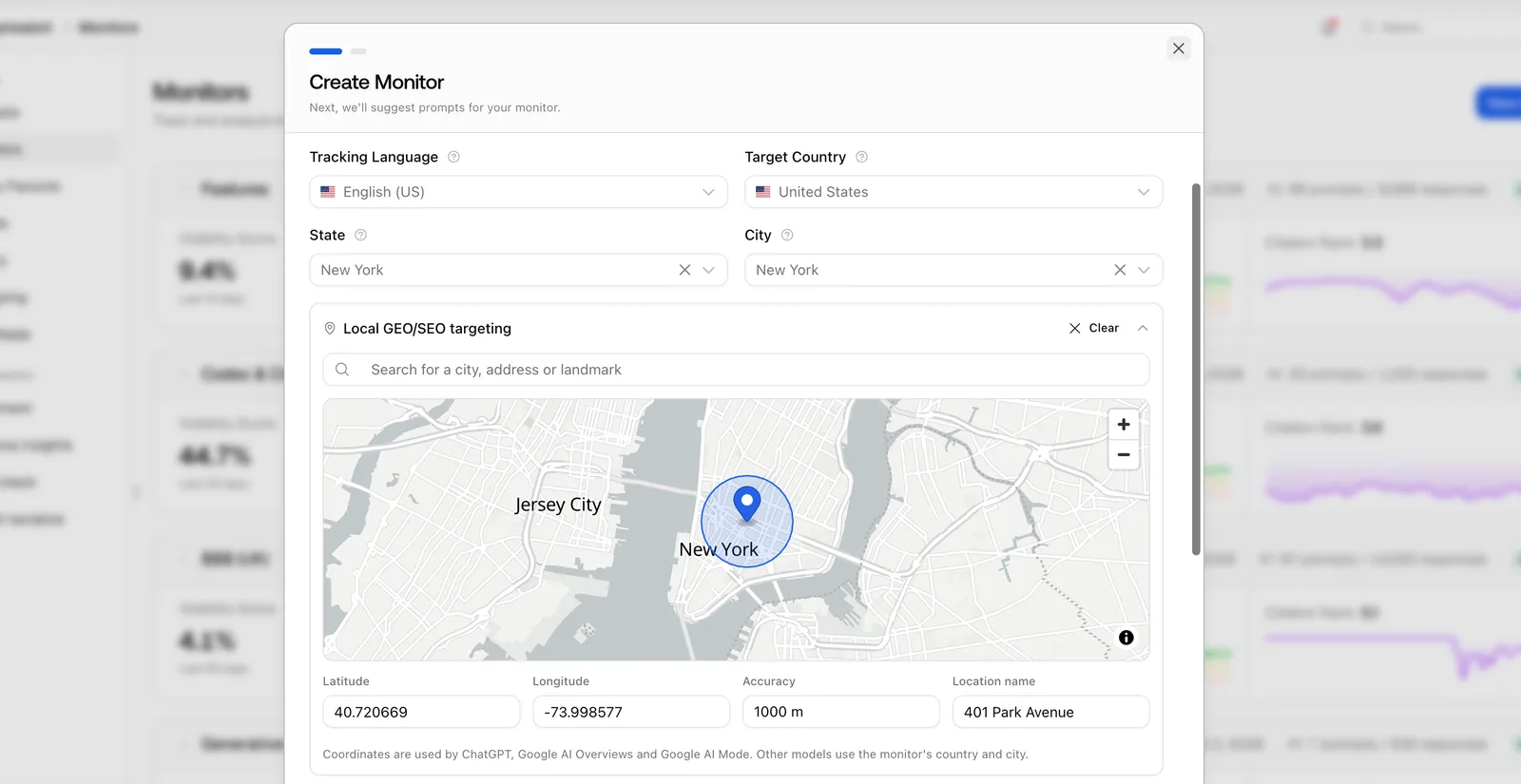 Promptwatch's Local GEO/SEO targeting, from the Promptwatch changelog, captured November 6, 2026. Example project data.
The engines treat the pin differently, which affects how we read the results. ChatGPT uses the exact point. Google AI Overviews and Google AI Mode use the nearest named area to it. Other models use the monitor's country, state, or city. So if a client's description differs between ChatGPT and Gemini on the same prompt, part of the difference may simply be that the two engines think the question came from slightly different places. Coordinate targeting is on Business, Agency Scale, and Enterprise.
For a business with several locations, we set up one monitor per location, each with its own prompts. A monitor's language and location are fixed once it's created, so the per-location history stays clean.
The prompts we track for a local business
Local perception prompts follow the same logic as any perception set (branded, comparison, objection, category), adjusted for how people ask about local services:
- Category with a constraint: "emergency plumber in Haarlem open on Sundays", "plumber for old canal houses in Haarlem".
- Branded: "is Harbor Plumbing reliable?", "what areas does Harbor Plumbing cover?", "Harbor Plumbing opening hours".
- Comparison: "Harbor Plumbing or [competitor] for a boiler replacement?"
- Objection: "Harbor Plumbing complaints", "is Harbor Plumbing expensive?"
Harbor Plumbing is a made-up example, but the pattern holds. The branded and objection prompts are where factual errors and reputation issues show up. Category prompts tell you whether the business gets a meaningful description at all, or just a name in a list.
What AI gets wrong about local businesses
In Brand Narrative, claims get filed under nine themes. For local clients, four of them do most of the work:
- Company, which covers facts about the business itself, including where it operates. Service-area errors land here.
- Support, which covers customer service and delivery. For a service business, response time and how the job went.
- Quality, which covers reliability and how well it works.
- Reputation, which covers ratings, reviews, and overall verdicts.
The errors we see most often in local work are factual rather than tonal. Wrong hours, a closed location still described as open, a service area that changed, a specialty the business dropped. Those are frustrating because they're easy to fix at the source and expensive when left alone: a model that tells someone you're open on Sunday when you aren't creates a bad experience before the customer ever calls.
Tonal problems (mixed reviews, "slow to respond") usually trace back to review profiles. Those take longer, because the reviews are written by customers, not by you.
What we change first
Here's the order we work in for a new local client. It's deliberately boring.
One set of business facts, everywhere
Name, address, phone, hours, service area, and the main services, stated identically on the business's own site and on every listing it controls. Local SEO has preached consistency for years. For AI it matters in a slightly different way: an engine that reads three listings with three different opening times may pick any of them, or blend them into something wrong. We collect every listing the client controls, fix the conflicts, and write down who owns each profile so it stays fixed.
Location pages that state things plainly
A location page that says "serving the greater Haarlem area" leaves the model to guess what that means. We rewrite location pages to state the facts in full sentences: which neighborhoods and towns, which services at this location, the hours, what's different about this location. If a model quotes the page, we want the quote to be correct. One location page per real location, not a template with the town name swapped.
Review profiles that are current and answered
We can't write reviews and we don't try to. What we can do is make sure the profiles the client controls are complete and current, that the business responds to reviews (especially critical ones, with specifics about what changed), and that happy customers are asked to leave a review in line with each platform's rules. If a complaint keeps showing up in AI answers and it's fair, the fix is operational, and we tell the client so.
After the basics
Once the facts are consistent, we start working on the claims. On Business, Agency Scale, and Enterprise, Fact Check can verify a claim about the client against the client's own crawled pages and up to 50 of the most-cited pages AI uses, which is useful for catching a directory listing that still has old hours. Brand Narrative's claims table, sorted most negative first, shows which complaints AI repeats most and which models repeat them.
We cover the Google Business Profile question separately in does a Google Business Profile influence whether AI assistants recommend a local business, because the answer depends on the engine.
Measuring it
We run local programs on Promptwatch because city monitors, coordinate targeting, the Directory source type, and Brand Narrative are in one project. For a single-location business, Business is usually the plan that makes sense, since city and coordinate tracking start there. If you'd rather see it first on your own locations, book a Promptwatch demo and bring the three prompts your customers ask most.