How we report share of answer when ChatGPT cites ten or more domains
Almost half of cited ChatGPT answers draw on ten or more domains. Why a cited or not cited report misleads clients, and the metrics we report instead.
Picture a monthly report with a green tick next to a prompt: "Cited in ChatGPT." The client is pleased. Then someone on their team opens the actual answer and finds the brand's page is the ninth of eleven sources, and the brand itself is mentioned once, near the bottom, after four competitors. Was that a win?
That scenario is the reason we stopped reporting AI visibility as a yes or no. Promptwatch's data on how many domains ChatGPT cites per answer shows how crowded these answers usually are, and a binary metric can't describe a crowded answer honestly.
How crowded ChatGPT answers are
Promptwatch's report How many unique domains does ChatGPT cite per response? looks at ChatGPT responses with at least one citation from September 28 to October 4, 2026. Several URLs from the same domain count as one domain, and the last bucket groups everything at ten or more.
The headline from the unique domains report (September 28 to October 4, 2026): 47.6% of ChatGPT responses with at least one citation cited 10 or more domains. 66.1% cited at least eight. Only 6% cited three or fewer, and 1% cited a single domain. The share rises with every extra domain from one to nine, so the typical cited answer is not a short list.
It depends on the kind of prompt. The same report, for the same September 28 to October 4, 2026 window, splits it three ways (unique domains report):
- Organic prompts, where no brand is named, are the most crowded. 52.5% cite ten or more domains, 71.8% cite at least eight, and only 4.5% cite three or fewer.
- Brand-specific prompts draw on far fewer sites. 21.3% cite ten or more, 13.8% cite three or fewer, and the most common count is five domains (14.9%). 40.7% cite five or fewer.
- Competitor comparison prompts are nearly as crowded as organic ones. 49.1% cite ten or more, 66.5% cite at least eight, and just 0.35% rely on a single domain, the lowest of the three types.
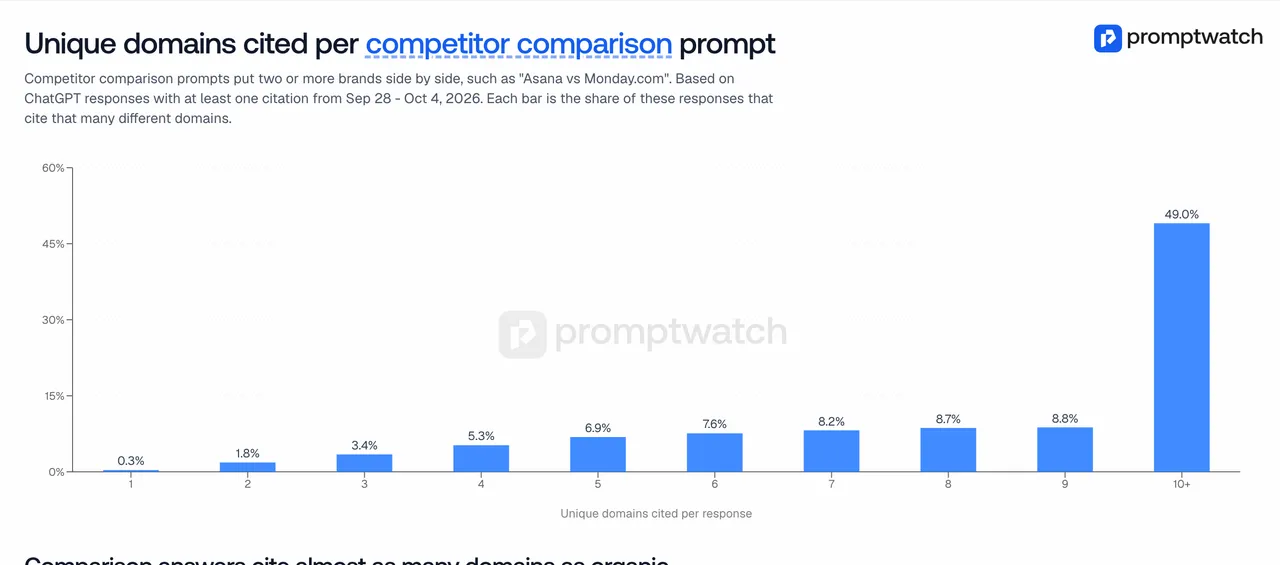 Promptwatch's "Unique domains cited per competitor comparison prompt" chart, captured November 14, 2026. We quote the report's text figures; the chart labels round some values slightly differently.
Why "cited or not" misleads
In an answer with ten or more sources, being cited tells you very little on its own. Our read, based on the data above and on reading a lot of client answers: what matters is where you appear, how often you are named compared with competitors, and whether the answer actually uses your page or just lists it.
A binary report also hides movement. A client can be "cited" in month one and month three while sliding from the second source to the ninth. Or they can be "not cited" on a prompt where they are named prominently in the text, because the answer used a review site as the source. Both are real changes the client should hear about, and a tick box misses both.
The brand-specific finding cuts the other way. When a buyer asks about the client by name, answers draw on fewer sources: 40.7% cited five or fewer domains in the September 28 to October 4, 2026 window (unique domains report). That is the one place where the client's own site has a good chance of being a primary source, and where being absent is a clear problem.
The metrics we report instead
We report five measures, each answering a different question. The definitions are Promptwatch's, since that is where we measure them.
Visibility Score
A 0 to 100 score for how prominently the brand appears in answers to tracked prompts. Each response is scored on placement, share of attention, and depth, then averaged, and responses without the brand count as zero. It's the closest thing to a single number for "how visible are we," which is why it goes first. We never show it alone.
Share of Voice
The brand's slice of all brand mentions within the current filters, counting one mention per response per brand. In a crowded answer that names six companies, Share of Voice tells you whether the client is one of the six and how that compares across many answers. We go into its pitfalls in how we read share of voice for a client.
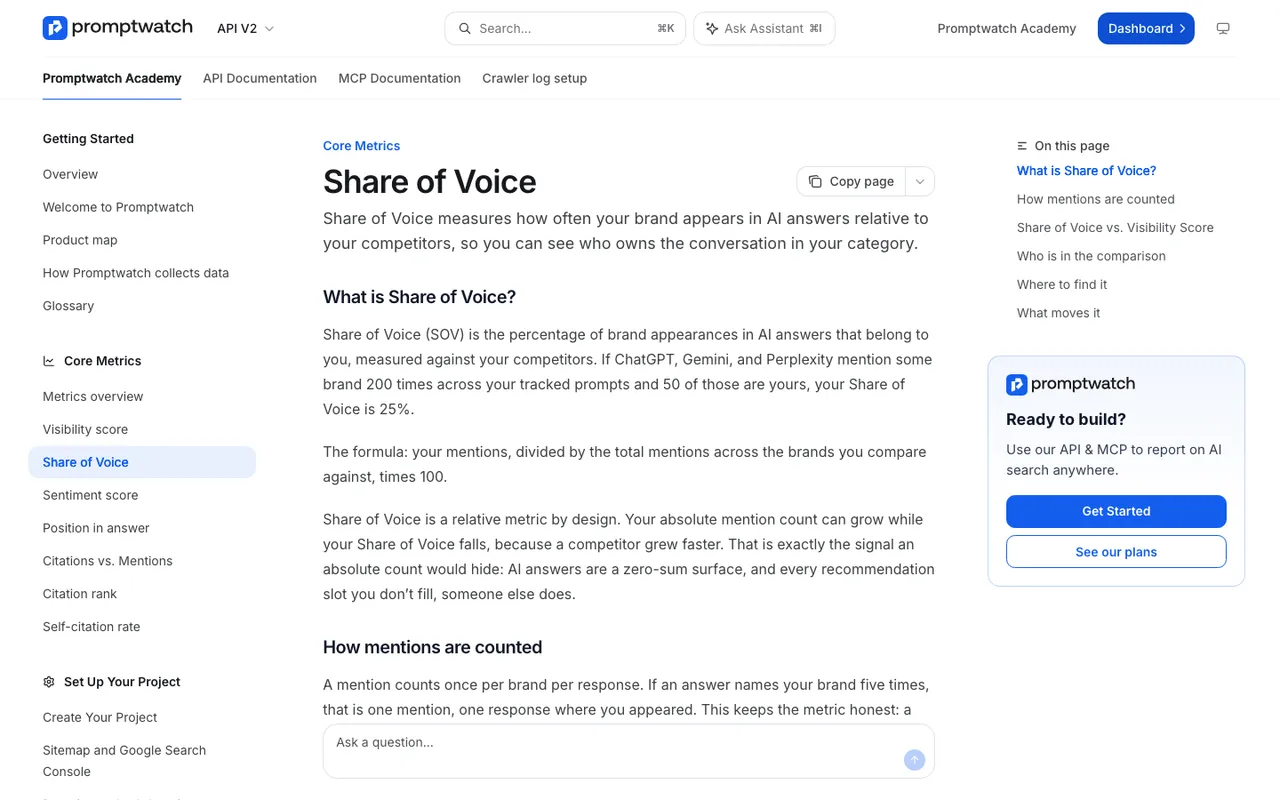 Promptwatch Academy's Share of Voice page, captured November 14, 2026. The figures in its example are illustrative.
Position
Where the brand lands in the order of brands named within an answer, averaged across responses that mention it. Lower is better. In a list of eight companies, being named first and being named seventh are very different outcomes, even though both count as a mention.
Citation rank
Where the client's own domain lands in an answer's source list, closer to 1 meaning a primary source. This is the direct answer to the ninth-of-eleven problem. It separates "our page was the main source" from "our page was one link among many."
Self-citation rate
The share of citations pointing at the client's own domain rather than third-party pages. A brand that is named often but rarely cited from its own site has a content or crawlability problem. A brand cited mostly via review sites is relying on others to describe it.
How we read them together
Promptwatch's own guidance gives a simple diagnostic that we use in nearly every report: low Share of Voice is a coverage problem, a late Position is a prominence problem, mentions without self-citations point to a content or crawlability problem, and weak sentiment points to a reputation problem. Each diagnosis leads to different work. Coverage means more pages and more third-party presence. Prominence means better answers and stronger reviews. Self-citation means fixing the site.
We split all of it by prompt type, because the unique-domains data shows organic, brand-specific, and comparison answers behave so differently. A client's organic prompts sit in the most crowded answers, so we judge them on Share of Voice and Position. Their brand-specific prompts draw on fewer domains, so we expect a strong citation rank there and flag it when it isn't. Comparison prompts get their own line, since only 0.35% of comparison answers relied on a single domain in the report's window (September 28 to October 4, 2026, unique domains report) and the client is always one of several.
What the client report looks like
Our monthly AI visibility section has four parts.
- A summary line with Visibility Score and Share of Voice against the tracked competitors, with the change from last month and from three months ago.
- A table by prompt type (organic, brand-specific, comparison) with Share of Voice, average Position, and citation rank for each.
- The five prompts that moved most, up or down, with the answer text so the client can see what changed.
- What we did, what we'll do next, and why.
We link each number to the answers behind it, because clients trust a metric more when they can read the responses that produced it.
Where we measure it
We run client reporting on Promptwatch, the platform we use for every client program. Visibility Score, Share of Voice, Position, citation rank, self-citation rate, and sentiment are all available per prompt, model, topic, and prompt type. Custom dashboards can hold the client's report layout, and scheduled PDF reports send it on a fixed day. Custom reports and the Looker Studio connector start on Professional for brand plans and are on every agency plan, which suits agencies that blend AI visibility into a wider SEO report.
We don't promise clients a particular Share of Voice or a top position. We report where they stand in crowded answers, what moved, and what we're doing about it.
If you'd like help setting up this kind of reporting for your own team, talk to a Promptwatch expert. The unique-domains report and related data are on the Promptwatch data index.