LinkedIn company page fixes for B2B clients
Company pages took a third of ChatGPT's LinkedIn citations in August 2026. Our company page checklist for B2B clients, and how we check what AI engines cite.
The LinkedIn company page is often the most neglected asset in a B2B marketing stack. It gets set up once, the logo gets swapped after a rebrand, and then nobody touches the About section for three years. That used to be a minor sin. Promptwatch's LinkedIn data suggests it now costs something in AI search, because company pages are one of the LinkedIn page types AI engines cite most, and their share grew over the summer.
This post covers what the August data shows, the checklist we run on B2B clients' company pages, and how we check whether it made a difference.
What changed between June and August
Promptwatch's LinkedIn citation page types report for August 2026 breaks down every LinkedIn citation by page type across ChatGPT, Google AI Mode, Google AI Overviews, and Perplexity. It covers August 1 to 31, 2026, and compares that with a May 18 to June 17, 2026 window. All percentages are of LinkedIn citations only, including categories the charts don't show.
Across all four engines, the August report shows company pages rising from 13.35% (May 18 to June 17, 2026) to 18.05% (August 1 to 31, 2026) of LinkedIn citations. The report says they gained on every engine, most of all on ChatGPT and Perplexity.
ChatGPT is where the change is largest (August report, August 1 to 31, 2026, against May 18 to June 17, 2026). Company pages went from 23.84% to 33.68% of ChatGPT's LinkedIn citations, a third. Job listings (6.51%) and help articles (5.97%) also show up, and the report says those three together make up close to half. Feed posts more than doubled in ChatGPT, from 12.09% to 26.45%, while Pulse articles fell from 8.77% to 3.65%.
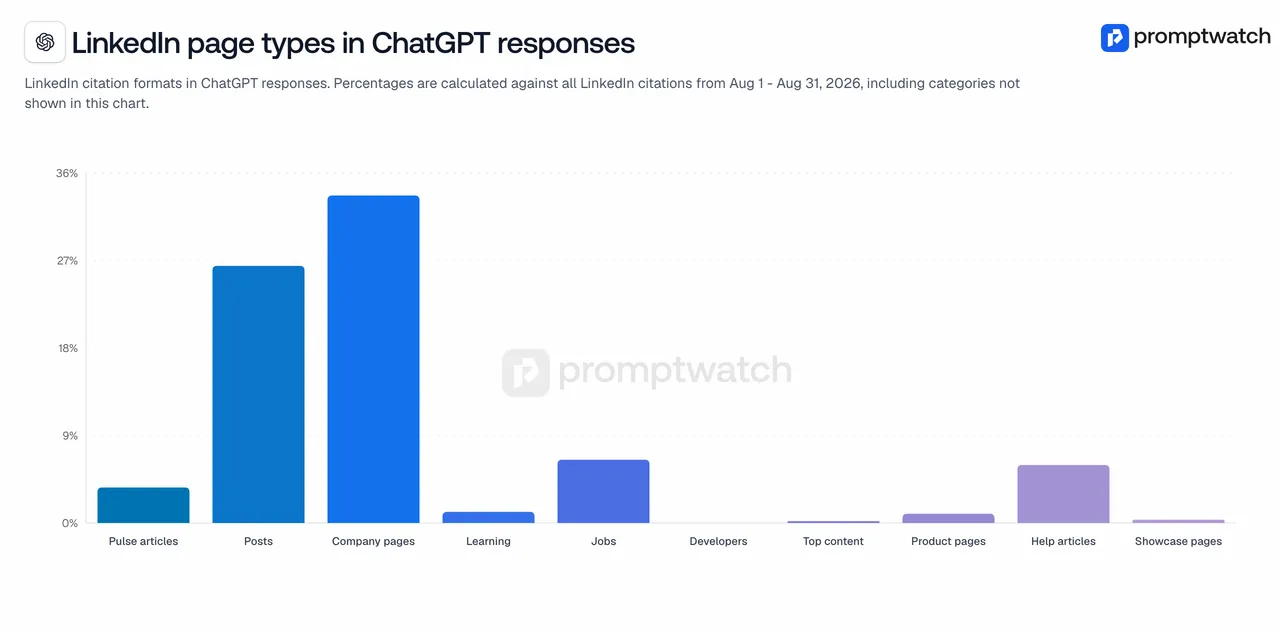 Promptwatch's "LinkedIn page types in ChatGPT responses" chart from the August 2026 LinkedIn report, captured November 14, 2026.
Perplexity moved the same way over the same two windows (August report). Company pages rose from 13.09% to 22.03% of its LinkedIn citations, the biggest gain of any page type there. Posts still lead on Perplexity at 37.32%, with Pulse articles at 26.01%.
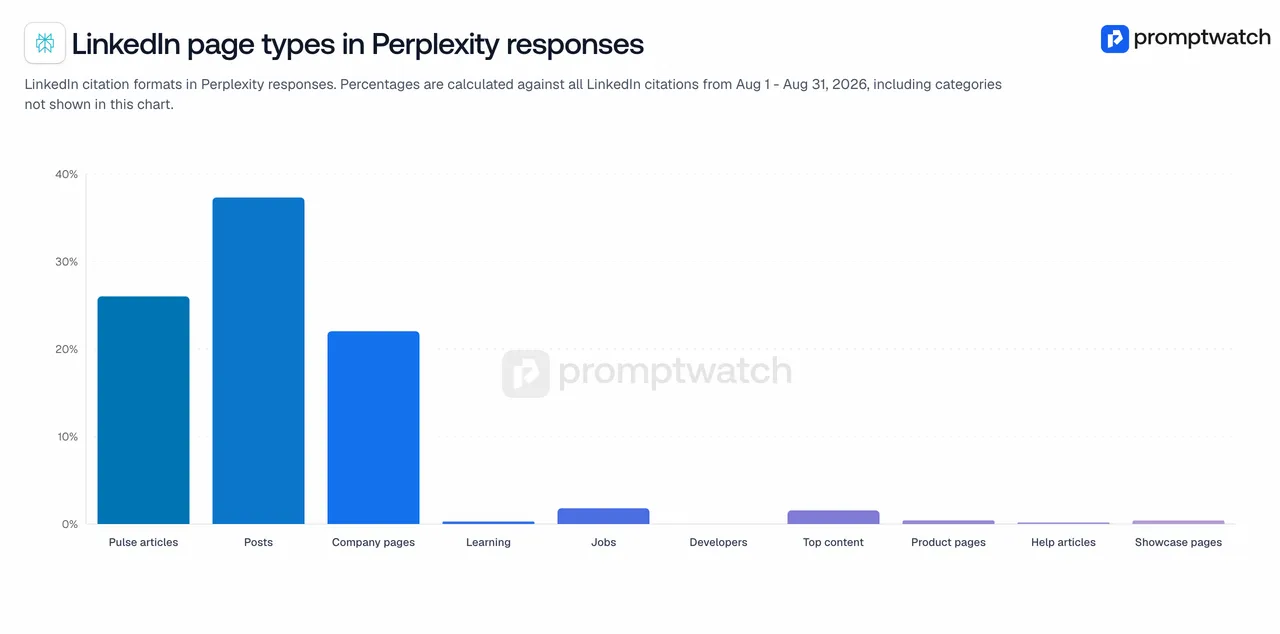 Promptwatch's "LinkedIn page types in Perplexity responses" chart from the August 2026 LinkedIn report, captured November 14, 2026.
Google's engines are different. In the August 1 to 31, 2026 data (August report), Pulse articles still lead there, at 34.66% in AI Mode and 34.51% in AI Overviews, with company pages lower (13.53% and 14.46%). And a few page types barely register anywhere: showcase pages at 0.4%, product pages at 0.44%, and LinkedIn Learning at 0.37% across all engines.
What it means for a B2B client
Our read: when ChatGPT or Perplexity needs to say what a company is, what it does, or whether it is hiring, the company page is an obvious source to cite. The report doesn't say why company pages gained, and neither do we know for certain. But the practical consequence is clear enough. Whatever the company page says is increasingly likely to end up in an answer about the client.
That makes the company page a factual record, not a branding exercise. If it describes a product line the client discontinued, lists the wrong headquarters, or uses a tagline that says nothing concrete, those are the facts an AI answer has to work with.
The engine split matters too. For ChatGPT-heavy audiences, the company page and feed posts carry most of the LinkedIn weight. For Google's engines, long-form Pulse articles still matter more. We plan LinkedIn activity per engine instead of applying one formula.
Our company page checklist
We run this on every B2B client's company page. None of it is advanced. Most pages fail several items anyway.
The About section says what the company sells
The first lines name the product or service, who it is for, and where the company operates, in plain words a buyer would use. We cut slogans that don't carry information. If a prospect read only those lines, could they say what the company does? If not, an AI answer can't either.
Facts match the website
Company name, industry, size range, headquarters, locations, and the website URL all match what the client's own site says. Mismatches are common after acquisitions, rebrands, and office moves. Conflicting facts across sources are a problem we'd rather not hand to an AI engine.
Specialties reflect current offerings
The specialties list often lags years behind. We update it to the products and services the client actually sells now and remove the old ones.
Jobs are real and current
Job listings show up in ChatGPT's LinkedIn citations (6.51% in August 1 to 31, 2026, per the August LinkedIn report). Stale or duplicated postings give a confusing picture of the company. We ask clients to close filled roles promptly and write job descriptions that also describe the company accurately, since that text may get read.
Posts on a steady schedule
Feed posts doubled their share in ChatGPT and lead on Perplexity. We plan a steady posting rhythm from the company page and from the people whose names buyers know: product updates, customer problems solved, clear explanations of how something works. Posts that state facts plainly do better in our experience than engagement bait, though that is practice, not something the report measured.
Pulse articles for Google-facing clients
For clients whose buyers start on Google, we keep publishing longer articles on LinkedIn, since Pulse articles still lead AI Mode and AI Overviews. For ChatGPT-focused clients, we spend that effort on posts and the client's own site instead.
Skip what barely registers
Showcase pages, product pages, and LinkedIn Learning were each under 0.5% of LinkedIn citations in August 2026 (August LinkedIn report, August 1 to 31, 2026). We don't recommend building showcase pages for AI search. If a client already has them, we make sure they're accurate and leave it there.
Link back to the site
The company page links to the client's main site, and the client's site links to the company page. It's ordinary hygiene that helps every system connect the two.
This checklist is about the company page itself. For tracking whether individual client posts get cited, see how we track client LinkedIn posts in AI search.
How we check whether it worked
The population report tells us company pages matter. Whether this client's company page gets cited, and for which prompts, is a separate question. We answer it in Promptwatch, the platform we run client programs on.
Promptwatch's LinkedIn citation report shows which LinkedIn posts, articles, and company pages are cited in answers to the client's tracked prompts. The "My channels" filter separates the client's own LinkedIn presence from everyone else's, so we can see whether the client's company page is cited or whether answers lean on a competitor's page or an employee's post instead. Top cited LinkedIn posts also appear on the main dashboard.
Filtering by model shows the engine split for the client. If ChatGPT cites the client's company page and AI Overviews cites a Pulse article from a competitor, those are two different fixes.
We record the state before we change anything, make the company page changes in one batch, and then compare over the following weeks. LinkedIn citations are a small share of all citations for most prompts, so we look for a trend across several weeks, not a single answer.
What we don't claim: that fixing a company page guarantees a citation, or that it will move overall visibility on its own. It removes a source of wrong or vague facts and puts accurate ones where AI engines are looking more often.
If you want to see which LinkedIn pages AI engines cite for your category, start with Promptwatch's 7-day free trial. The earlier LinkedIn report and the other social data are on the Promptwatch data index.