AI brand perception after a rebrand or name change
Why AI still uses your old brand name after a rebrand, how we track the old and new names, and the site, crawler, and source fixes we make in the months after.
A software company we'll call Northwind renames itself Lumen. New domain, new logo, a press release, a redirect map, the works. Three months later the CEO asks ChatGPT about Lumen and gets a decent answer. Then a board member asks a different engine "what does Northwind do?" and gets a confident description of the product as it was two years ago, including a pricing model the company dropped before the rename.
Every rebrand we've worked on has some version of this. AI still uses the old name, still attaches old facts to it, and sometimes treats the old and new brand as two separate companies. It isn't a sign the rebrand failed. It's what happens when the sources an engine reads haven't all caught up, and when some engines aren't reading live sources at all.
This post covers why old names persist, how we measure the transition, and what we fix, in roughly the order we fix it.
Why the old name sticks
There are two different mechanisms, and they need different responses.
The first is training data. Some models answer from what they learned during training rather than from a live web search. Promptwatch tracks several of these through their APIs, including Claude, DeepSeek, Mistral, and Grok. If the model was trained before the rename, it knows Northwind and may know nothing about Lumen. No amount of on-site work changes that answer until the model vendor trains a newer version, and nobody outside the vendor controls when that happens. We say this to clients on day one, because it's the part of the problem we can't touch.
The second is the live web. Engines like ChatGPT Search, Perplexity, Gemini, Google AI Overviews, and Copilot search the web when they answer. They read whatever ranks and whatever they can fetch. If directory profiles, old press coverage, partner pages, review sites, and your own forgotten blog posts still say Northwind, the live engines will keep finding Northwind. This half of the problem is very much fixable, and it's where most of our effort goes.
Set up tracking so the transition is measurable
Before fixing anything, we make sure the tracking can see both names. Otherwise the client's visibility appears to collapse the day of the rename (answers that say Northwind stop counting) and nobody can tell whether the old name is fading.
In Promptwatch we add the old name as a brand alias, so answers that still say Northwind count as a mention of the client. We also use the Brand Book's analysis instructions, which take up to 1,000 characters, to state plainly that Northwind and Lumen are the same company. Those instructions apply to new responses only, so we set them before the rename goes public if we can.
Then we add prompts written specifically for the transition:
- "What is Lumen?" and "What is Northwind?", tracked side by side.
- "Is Lumen the same company as Northwind?"
- "What happened to Northwind?"
- "Northwind vs [main competitor]", because buyers who knew the old name keep searching with it.
The claims table in Brand Narrative is where the old name shows up in practice. Search matches the claim text, and each claim keeps the verbatim quote it came from, so searching for the old name lists the claims that still use it, which models say them, and when each was last seen. The Company theme, which covers facts about the business such as ownership and founding, is usually where rename confusion lands. Over the months after a rebrand, we want to see old-name claims age out: still listed, but with a "last seen" date that keeps slipping further back.
Confirm the bots can see the new pages
Redirects are standard rebrand hygiene, and SEO teams know them well. What's different for AI is that you can check directly whether AI crawlers are following them.
Agent Analytics in Promptwatch shows IP-verified AI crawler visits, checked against each operator's published IP ranges so spoofed user agents are filtered out. It tracks bots including GPTBot, OAI-SearchBot, ChatGPT-User, ClaudeBot, Claude-SearchBot, PerplexityBot, and Perplexity-User, with top pages, error tracking with failure explanations, and a crawl-to-citation path that gives a citation rate per page.
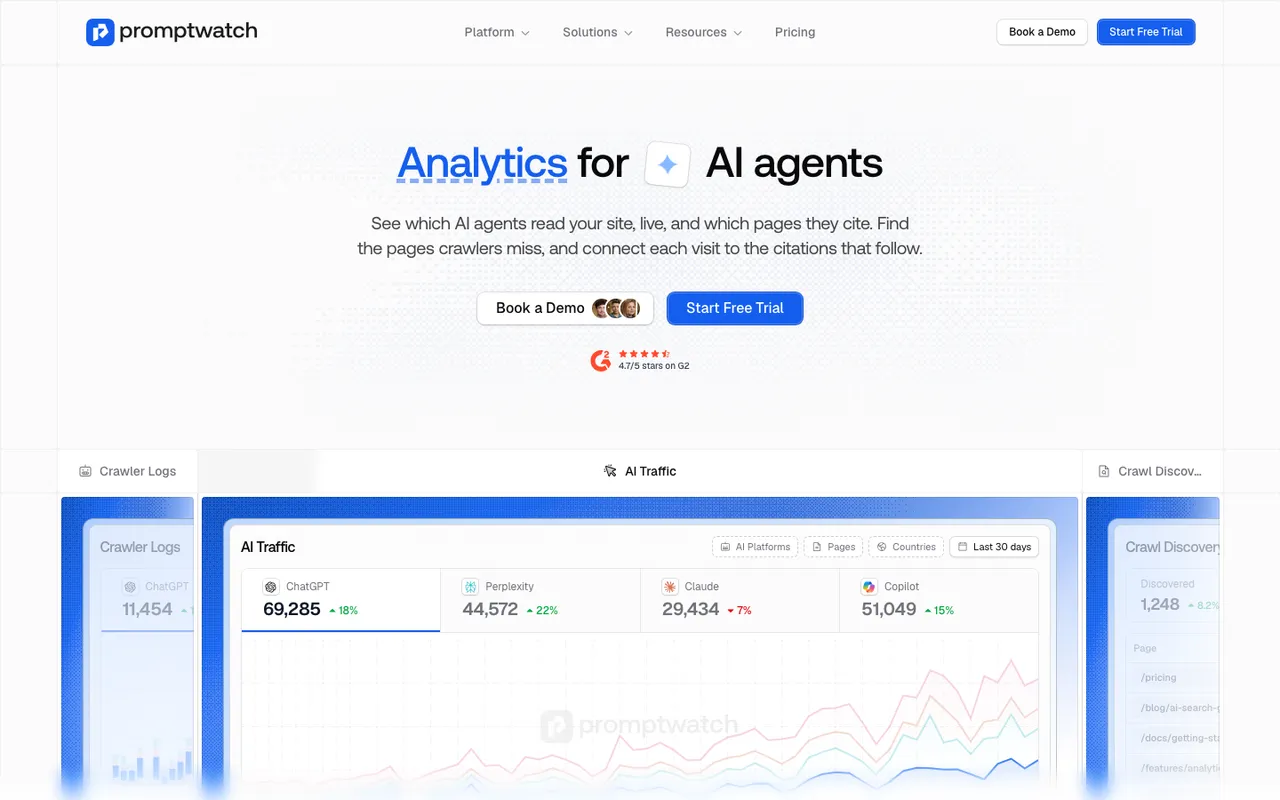 Promptwatch's Agent Analytics page, captured November 8, 2026. The dashboard figures are Promptwatch's own illustration.
After a rename we look for three things in those logs. Are AI crawlers hitting the old URLs and getting a clean redirect, or are they hitting errors? Are they reaching the new versions of the high-value pages (about, pricing, product, comparison pages)? And are those new pages getting cited, or only crawled? A new about page that bots fetch daily but no engine cites usually has a content problem: it may not state the rename in a sentence a model can quote.
Crawler logs start on the Professional plan ($245 a month). For a rebrand they're worth it for the transition period alone, because they replace guesswork about whether bots have seen the new site.
State the rename once, clearly, and then stop
A common instinct is to sprinkle "formerly Northwind" across the whole site. We do something narrower. One plain statement of the rename goes on the pages where a buyer or a model would look for company facts: the about page, the press or newsroom page, and the FAQ. Something like "Lumen is the new name of Northwind. The company, team, and product are the same." The rest of the site uses only the new name.
The reasoning: a model that reads the about page gets the connection stated outright. A model that reads the product page sees only Lumen and describes Lumen. Repeating the old name everywhere keeps it in circulation longer than necessary.
Find the pages still teaching the old story
This is where Fact Check earns its place. On Promptwatch's Business plan ($579 a month), Agency Scale, and Enterprise, you mark a claim about your own brand as Accurate or Inaccurate, and a check reads every page Promptwatch has crawled from your site, plus up to 50 of the most-cited pages AI uses, looking for passages that state the claim or the opposite.
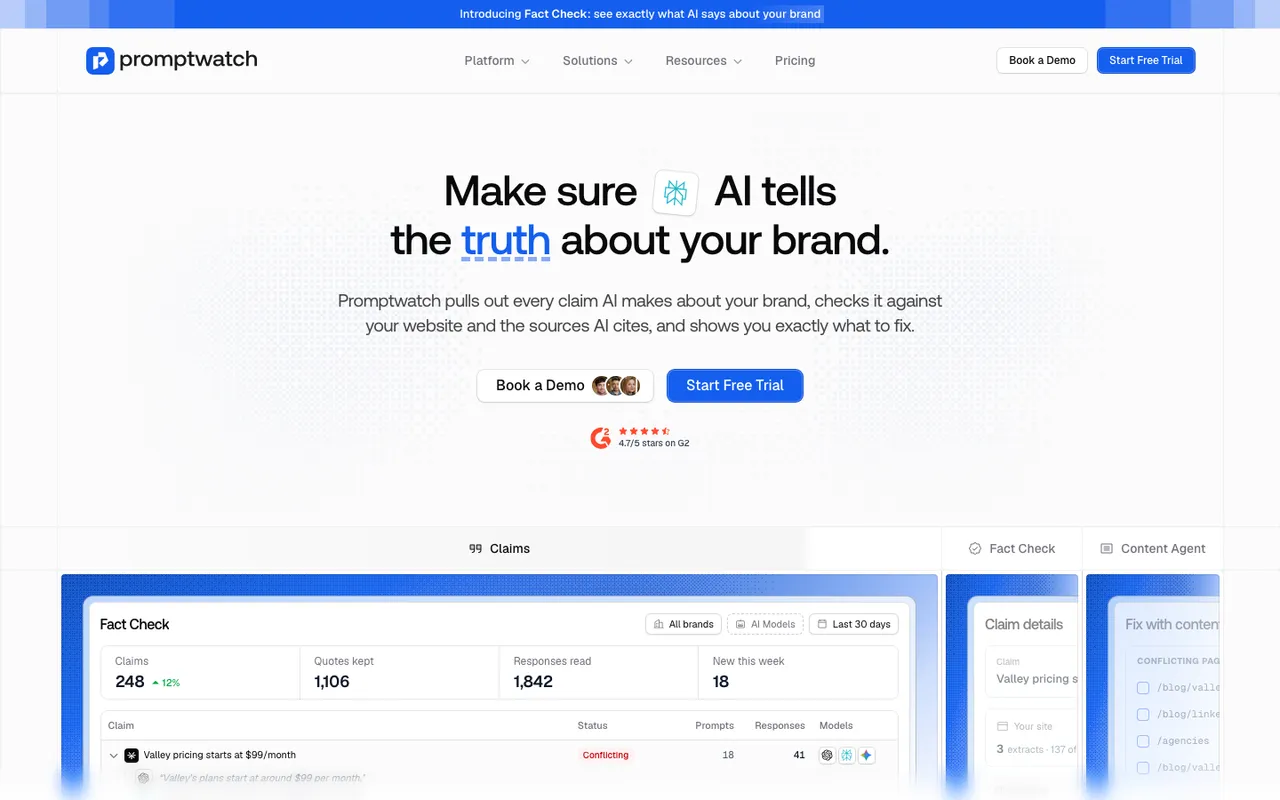 Promptwatch's Fact Check feature page, captured November 14, 2026. The claims shown in the product view are the vendor's own illustration.
For a rebrand, typical inaccurate claims are things like an old ownership structure, a discontinued product line, or a business model the company left behind. When a check comes back Conflicting because the client's own site still states the old fact, that page is where AI is getting it. Rebrands are full of these: an old blog archive migrated without review, a PDF datasheet nobody updated, a careers page with the old company description.
When a check flags pages on the client's own site, "Fix with content agent" opens a Content Refresh for each flagged page, with the sentences to rewrite attached and a field for what's actually true. Each refreshed page uses an AEO article from the plan's quota, and agency plans don't include AEO articles, so on Agency Scale we make those edits by hand. One detail we like: the agent is told to remove the wrong claim without repeating it, not even to deny it. That matters after a rebrand, because a page that says "Lumen no longer offers the old Northwind licence" still puts the old licence in front of the model.
Fact Check reports what pages say, not what's true. The client decides which claims are wrong. Our job is to find where they come from.
Then work outward to the sources you don't own
Third-party pages take longer, and there's no tool that edits them for you. We work from the citations rather than from a generic list of every site that ever mentioned the old name.
In Brand Narrative, each claim has a Citations tab showing the pages cited alongside it. The Academy is careful to say a cited page isn't necessarily the source of the claim, but it's the first place to look. Offsite mentions in Promptwatch also list third-party pages that name the brand without linking, ranked as opportunities. For a rebrand, the usual targets are directory and review profiles the client controls but forgot to update, partner and integration listings, and older comparison articles. Profiles you own you can fix in an afternoon. Articles you don't own mean an email to the publisher with the new name and a link to the about page.
What to expect, and when to stop worrying
Live-search engines usually follow the sources. As the pages they read switch to the new name, the answers follow, at a pace that depends on how often those pages get fetched and how many still carry the old name. Training-data models follow their own release cycle. We tell clients to expect a long tail and to judge progress by trend: fewer old-name claims, more recent "last seen" dates moving into the past, a rising share of answers to "what is Lumen" that get the current facts right.
If you're planning a rename, or you're already a few months past one and AI is still confused, we'd start with the measurement setup above. We run this work on Promptwatch, and the fastest way to see your own transition is to book a Promptwatch demo and ask them to show both names in Brand Narrative.