The first 30 days of fixing AI brand perception
A week-by-week plan for the first month of improving how AI describes your brand: baseline, claims and sources, fixes, and an honest re-measure at the end.
Thirty days is long enough to find out what AI engines say about a brand, trace the worst claims to their sources, and fix the ones that sit on pages you control. It's not long enough to see every fix reflected in every engine, and anyone who promises that is guessing. With that expectation set, a month is a good unit of work. It forces a sequence, and the sequence matters more than any single tactic.
This is the plan we follow when a client wants to improve how AI describes them and doesn't know where to start. Four weeks, one job per week, run from a single task board so nothing gets lost between the people involved.
Before day one: agree on what "better" means
A short conversation saves a wasted month. We ask the client three questions. Which descriptions of the brand would you most like AI to get right? Which claims, if a buyer heard them, would cost you a deal? And who on your side can approve changes to the website, the listings, and the messaging?
The answers become the brief. Perception (how AI describes a brand when it names it) can drift in a dozen directions, and without a brief the first month turns into an interesting tour of all of them.
Week 1: take the baseline
A free first look
On day one we run Promptwatch's free AI Visibility Report. You type in the website, and it reads the robots.txt, works out what AI thinks the business does, then asks ChatGPT, Gemini, and Perplexity the kind of questions a buyer would ask, live, in a couple of minutes. It needs no account.
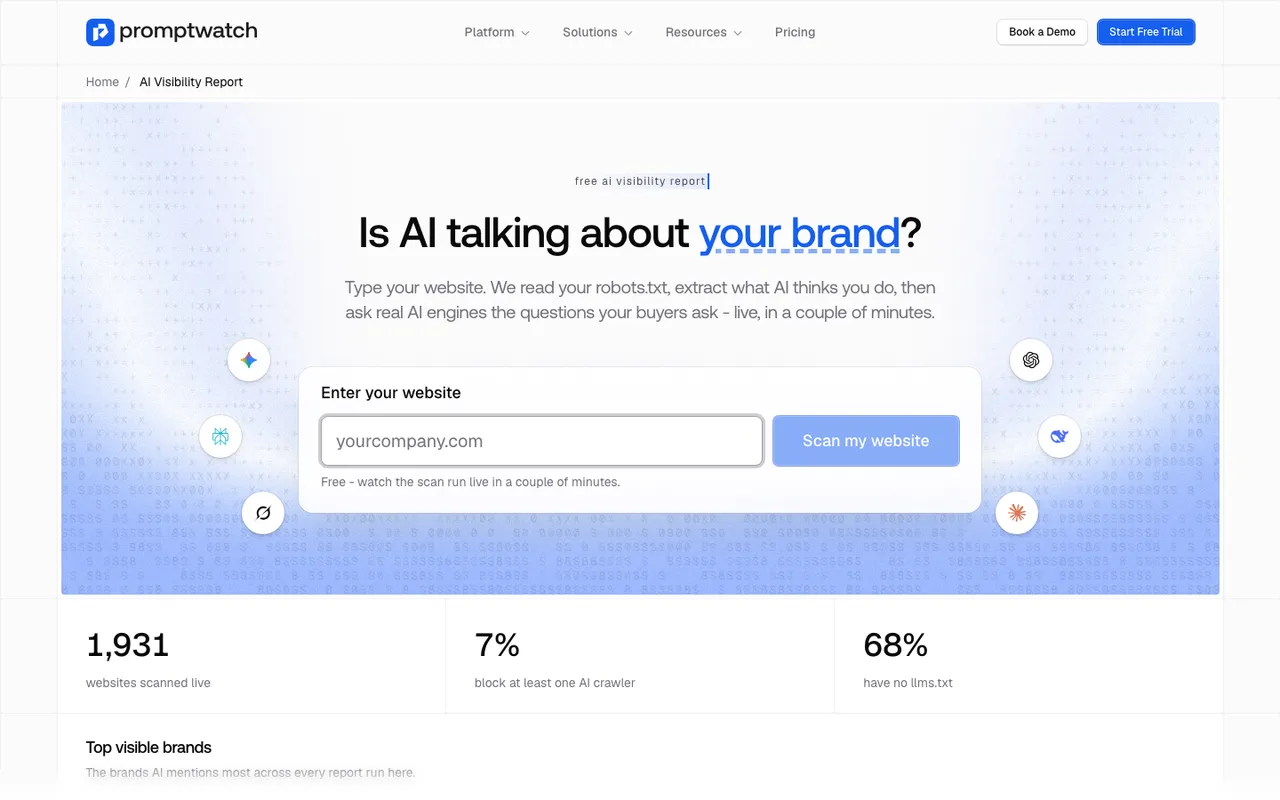 Promptwatch's free AI Visibility Report page, captured November 6, 2026.
The report isn't a perception audit. It's a quick check of two things we need to know before anything else: whether AI crawlers are blocked, and whether the engines' basic understanding of the business is right. If the report shows AI thinks the client sells something they stopped selling, that becomes the first item on the list.
Set up tracking
Then the real instrument. In a Promptwatch project we set up the client's brand, aliases, and competitors, write the Brand Book's analysis instructions (they apply to new responses only, so they go in before data starts), and create monitors for each market. A monitor's language and location are fixed once created, so this needs care.
The prompt set for perception work has four families: branded questions ("what is Acme?", "is Acme good for agencies?"), comparisons with named competitors, objection prompts ("is Acme worth it?", "Acme complaints"), and category prompts with a real constraint. Objection prompts matter most in the first month, because they surface the negative claims fastest.
The 7-day free trial on monthly billing covers this first week on any self-serve plan. If the client continues, the plan choice depends on what the month needs: Essential ($95 a month) covers Brand Narrative and Sentiment, Professional ($245) adds crawler logs and AEO articles for Content Refresh, and Business ($579) adds Fact Check.
Week 2: read the claims and find the sources
By the second week there's enough data to read. We do it in a fixed order.
Start with Brand Narrative's Negative tab. Brand Narrative pulls the individual claims AI makes about the brand out of every tracked response, groups repeats, and sorts the claims table with the most negative at the top. For each negative claim, we check how many responses repeat it and which models say it. A claim one model made once goes on a watch list. A claim several models repeat goes on the fix list.
Sort each claim into one of three buckets: fair criticism, outdated, or wrong. Fair criticism ("the mobile app has fewer features than the desktop version", when that's true) isn't a content problem. Outdated claims (a limitation that was fixed last year) and wrong claims need a source.
Then find the sources. Each claim in Brand Narrative has a Citations tab showing the pages cited alongside it. The Academy is careful to say that a cited page isn't necessarily where the claim came from, but it's the first place to look. On the Sentiment page, filtering to scores below 30 and reading the responses in full shows which sources the most negative answers lean on.
On Business, Agency Scale, and Enterprise, Fact Check makes this step much faster. Mark a claim Inaccurate, and a check reads the client's crawled pages and up to 50 of the most-cited pages AI uses, quoting the sentences that state the claim or the opposite. A result like "your website contains conflicting information" usually means an old page is contradicting a current one.
By the end of week two we have a list: each claim to fix, its bucket, and the pages behind it, split into pages the client owns and pages they don't.
Week 3: fix what you control
This is the week most teams want to start with. Starting here without weeks one and two means fixing pages at random.
Pages the client owns come first, because they're entirely within reach. An old blog post that contradicts the current pricing page gets updated or removed, so AI sees one answer. A fact the site only hints at gets stated plainly, because AI repeats what pages say outright. On Professional and higher, Content Refresh drafts diff-style updates to existing pages, and on Business, Fact Check's "Fix with content agent" opens a refresh for each flagged page with the sentences to rewrite already attached. Each refreshed page uses an AEO article from the plan's quota.
Crawl access comes next. If AI crawlers can't fetch the corrected pages, the correction doesn't reach the engines. On Professional and up, Agent Analytics shows IP-verified crawler visits per page, so we can confirm bots such as GPTBot, OAI-SearchBot, and PerplexityBot are reading the updated URLs.
Third-party pages get their first round of outreach: claimed directory and review profiles updated, polite correction requests sent to publishers of cited pages with stale facts. Those take longer than a week to land. Starting them in week three means some will be live by the time the next month's reading comes in.
Running it on the Action Board
All of this runs from Promptwatch's Action Board, a kanban board of GEO tasks with five columns: Suggested, To Do, In Progress, Done, and Dismissed.
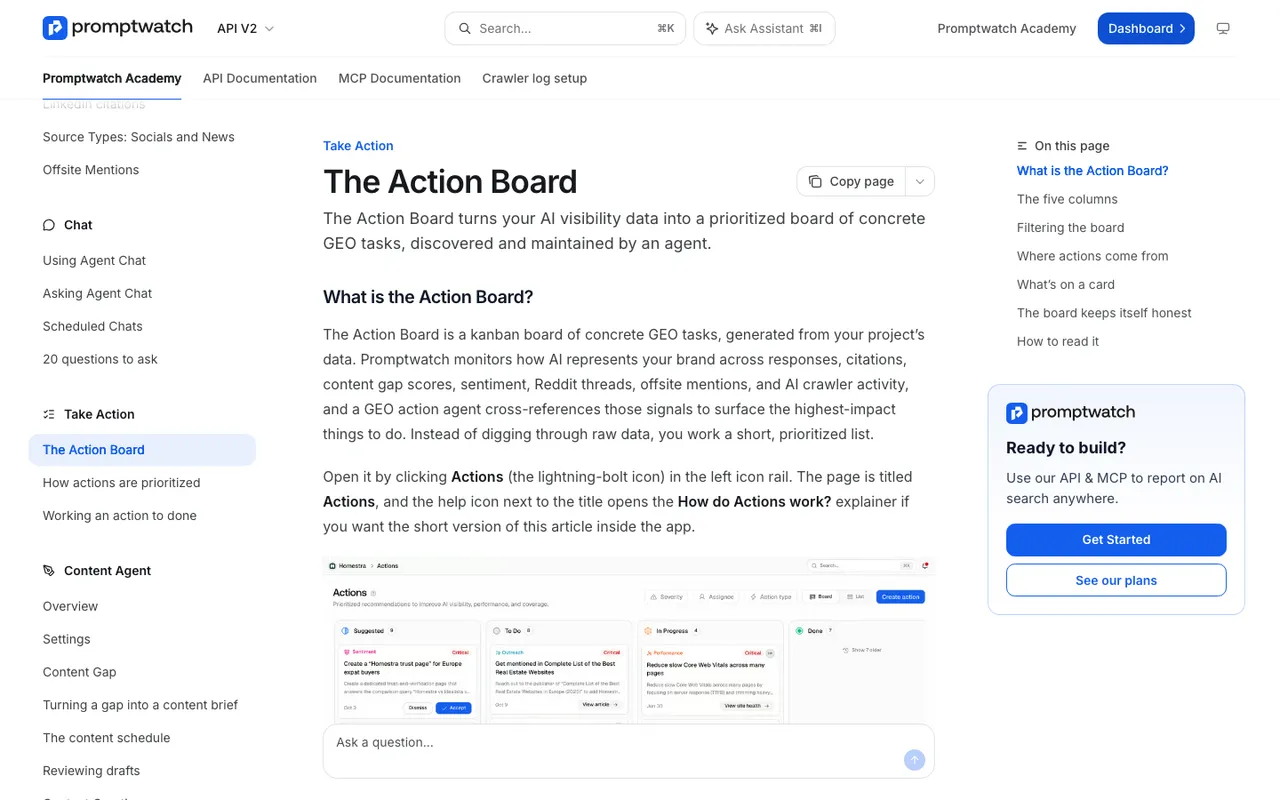 Promptwatch Academy's Action Board page, captured November 14, 2026.
Three sources feed it. A discovery agent investigates the project's data on a weekly schedule, one focus per day (sentiment is one of them), and suggests up to five evidence-backed actions per run into Suggested, for us to accept or dismiss. Setup actions appear automatically when a core integration is missing, such as uploading the sitemap or connecting Google Search Console, and land in To Do at High severity. And we add custom actions ourselves for each claim on the week-two list, with an owner and a severity.
The board matters in a 30-day plan because the work crosses teams. The SEO lead fixes pages, the content writer drafts refreshes, the PR lead sends outreach, and the client approves. One board with assignees and comments beats four email threads.
Week 4: re-measure, honestly
The last week is for reading the results without overselling them.
Brand Narrative collects claims from new responses as they come in. For each fix, we set the date range to the days after the change and check whether the claim is still being repeated, by which models, and how recently. On the plans with Fact Check, its accuracy score (the share of checked mentions that are accurate, from 0 to 100) gives a single number to compare against week two. Fixed claims can be re-checked with Re-run fact check, and the check history shows whether a claim moved from Conflicting to Confirmed.
Some fixes will already show. Others won't, and that's expected. Live-search engines like ChatGPT Search and Perplexity follow the pages they read, so they pick up changes as they re-fetch those pages. Models that answer from training data, which Promptwatch tracks through APIs (Claude, DeepSeek, Mistral, and Grok among them), won't change until their vendors retrain them. We report the two separately so nobody concludes a fix failed because a training-data model hasn't moved.
The month ends with a short report: claims fixed, claims still repeated, outreach pending, and the list for month two. Month two is usually where the third-party work starts paying off.
Start the clock
We run these 30-day sprints for clients on Promptwatch, and the plan above is the same one we'd use for you. If you'd rather run it yourself, start the 7-day free trial on the day you agree the brief, and use the trial week to get week one right: brand, competitors, analysis instructions, and an objection-heavy prompt set.