YouTube for SEO clients: what the videos AI cites look like
Promptwatch's YouTube data shows AI engines citing modest, older videos from small channels. How we brief video for SEO clients: question-led, clearly described, built to last.
Most SEO clients picture the wrong video when we say "YouTube for AI search." They picture a polished brand film with a big launch, a paid push, and a view count to report upward. The data on which videos AI engines actually cite points somewhere much less glamorous: modest videos, from modest channels, that are often years old.
This post covers what that data shows, why it changes the way we brief video for clients, and how we check whether video is worth it for a given client in the first place.
Why YouTube is on the table at all
Start with the size of the opportunity, because it differs a lot by engine.
In Promptwatch's November 2026 social media citations report (October 11 to November 9, 2026), YouTube held 6.71% of Google AI Overviews' citations. That is more than the other six social platforms in the report combined, which together came to 6.45%. The report calls YouTube's rise in AI Overviews the largest change it measured against October.
The other engines look very different in the same window of the November report (October 11 to November 9, 2026). YouTube's share of Perplexity's citations was 0.31%, after falling by more than half from 0.79% in the October report (September 28 to October 4, 2026). In ChatGPT it was 0.03%.
So for clients whose buyers start on Google, YouTube is a serious channel. For a client whose audience lives mostly in ChatGPT, it's close to irrelevant as a citation source, whatever it does for brand awareness.
What the cited videos look like
The profile of cited videos comes from an earlier report: Promptwatch's YouTube citation data for February 2026, covering February 1 to 28, 2026, across ChatGPT, Perplexity, and Google AI Overviews. It predates the November figures above, so we don't mix the two periods. We use February for what cited videos look like and November for how much YouTube matters per engine.
Views first, from the February report (February 1 to 28, 2026). The largest group of cited videos had between 10K and 100K views, at 36%. Nearly 80% had under 100K views, and only about 7% had passed 1M.
Likes tell the same story in the February data (February 1 to 28, 2026). 43% of cited videos had under 100 likes, and 78% had under 1,000.
The channels are small too (February report, February 1 to 28, 2026). The 10K to 100K subscriber bucket was the largest, at 34%, and about 80% of citations came from channels under 100K subscribers. Channels with 1M or more subscribers earned 7%.
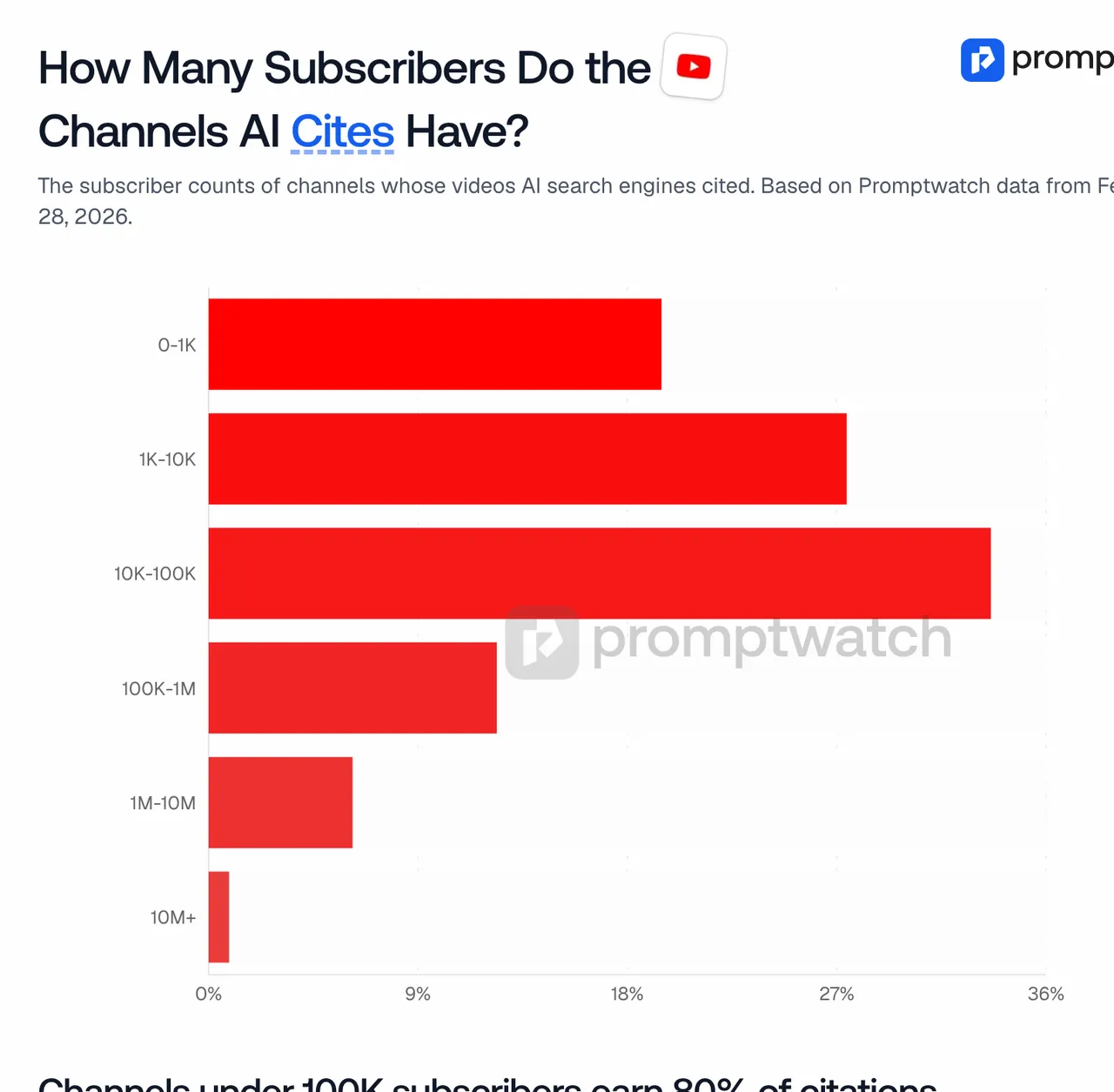 Promptwatch's "How Many Subscribers Do the Channels AI Cites Have?" chart from the February 2026 YouTube report (Feb 1 to 28, 2026), captured November 14, 2026.
And the videos are old. In the same February 2026 report (February 1 to 28, 2026), 54% were more than two years old, nearly 72% were over a year old, and about 4% were under a month old. The report says the videos cited at the time were mostly published in 2023 and 2024.
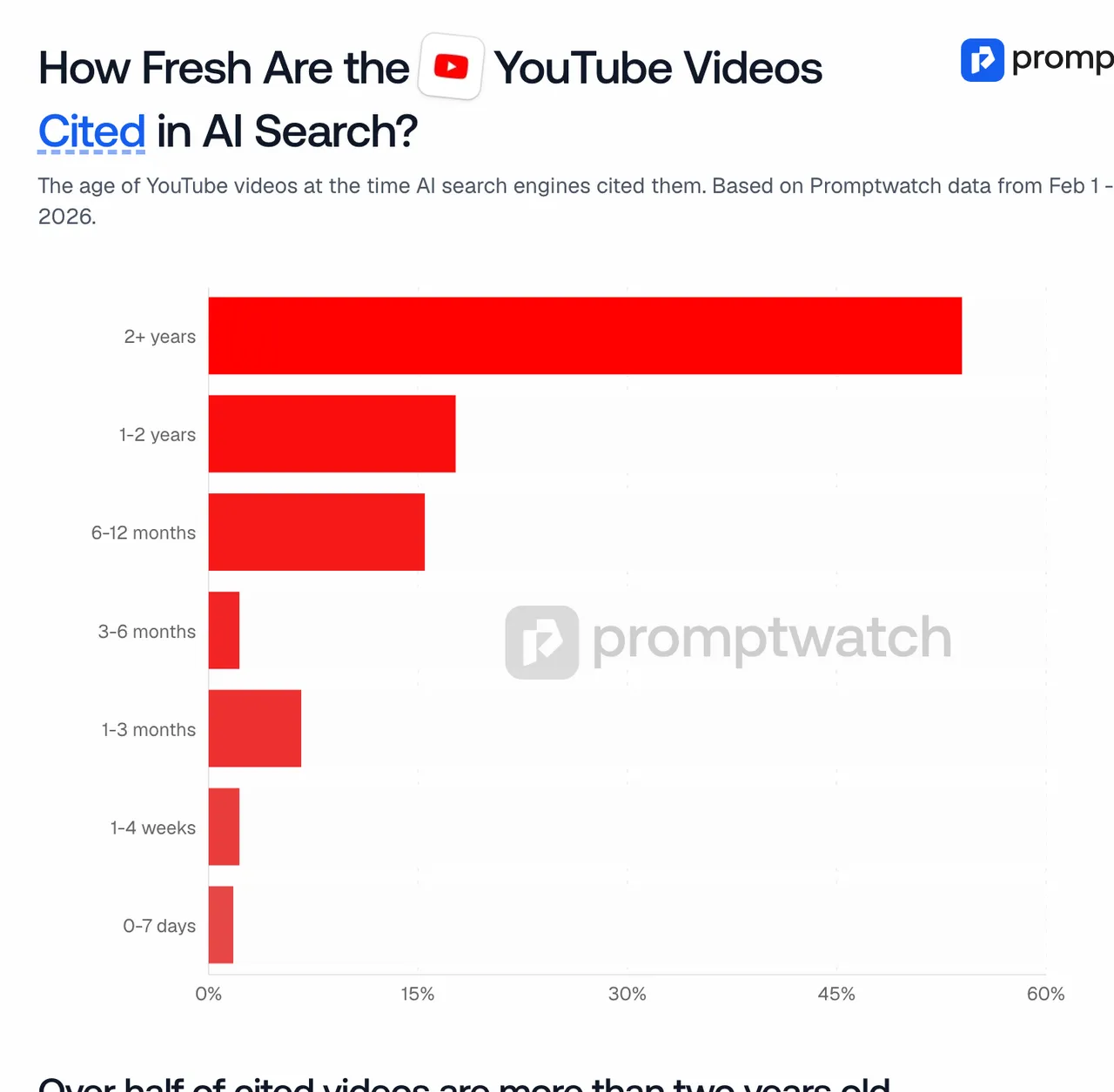 Promptwatch's "How Fresh Are the YouTube Videos Cited in AI Search?" chart from the February 2026 YouTube report (Feb 1 to 28, 2026), captured November 14, 2026.
What we take from it
Our read, labelled as ours: AI engines appear to pick videos for whether they answer the question, not for how popular they are. A modest tutorial from a specialist channel that explains exactly how to do something looks like the typical cited video. A viral brand video that answers nothing doesn't fit the profile.
The report itself suggests engines match on titles, descriptions, and transcripts. That is the page's inference, not something it measured, and we treat it that way. But it lines up with the profile: small, specific videos that say plainly what they cover.
The age data matters just as much for planning. If more than half of cited videos are over two years old, video is a long-horizon investment. A client who expects a new video to be cited next month is likely to be disappointed. A client who builds a library of answer videos over a year is building something that can keep earning citations for a long time.
How we brief video for clients
This is the brief we hand a client's video team, or the freelancer they hire. It doesn't need a studio.
One question per video
Each video answers one question a buyer actually asks. We pull those questions from the client's tracked prompts, Search Console queries, and sales calls. "How do I connect X to Y," "what's the difference between A and B," "how much does Z cost to install." If a question needs three answers, it becomes three videos.
The question in the title
The title states the question or the task in the words a buyer would use. Clever titles are for a different goal. We'd rather have a plain title that matches the query than a creative one that doesn't.
The answer early, in the description and on screen
The description opens with a short written answer, then lists what the video covers with timestamps. The spoken answer comes in the first part of the video, before any intro sequence. We ask for accurate captions, so the transcript is clean.
Keep it on a channel you'll keep
Since cited videos age well, a video on a channel the client might delete or rename is a poor investment. We put videos on the client's main channel and keep the channel name consistent with the brand.
Plan for a year, not a launch
We schedule video as a steady series, not a campaign. We revisit older videos when the product changes, updating descriptions and pinned comments rather than deleting and re-uploading, so the video keeps whatever history it has.
Connect it to the site
Each video gets embedded on the matching page of the client's site, with the written answer next to it. That is ordinary video SEO. It also means the client's own page and the video can support each other in search.
Our earlier post, YouTube citations in AI answers: what we do with them, covers the step before this one: deciding whether YouTube matters for a client at all.
How we check it per client
The population data says YouTube is big in AI Overviews. It doesn't say whether YouTube is cited for a particular client's prompts. We check that in Promptwatch, the platform we run client programs on.
Promptwatch's YouTube citation report shows which videos and channels are cited for the client's tracked prompts, with engagement figures, so we can see the actual competition: whose videos, how old, how many views. If the cited videos for a client's category are small tutorials from specialist channels, the client has a realistic shot. If the category has no YouTube citations at all, we spend the budget elsewhere.
Filtering by model separates AI Overviews from Perplexity and ChatGPT, which matters given how differently they treat YouTube. Dashboards can show a top YouTube videos widget, and when a Google AI Overviews or AI Mode answer contains a video card, Promptwatch opens it in the YouTube sheet at the moment the answer points to. That tells us which part of a video an answer relies on, which is useful when briefing the next one.
Once the client starts publishing, we watch the YouTube citation report and Citation Trends over months, not weeks, given how slowly cited videos accumulate.
To get a first read on where you stand before planning any video, run the free AI Visibility Report. The full YouTube and social reports are on the Promptwatch data index.