Travel clients: what ChatGPT cites for travel prompts and what we do about it
Promptwatch's October 2026 travel report shows booking and review sites leading ChatGPT's travel citations. How we split travel client work and measure it.
When someone asks ChatGPT where to stay, what to do in a city, or how to book a trip, which sites does it lean on? Promptwatch looked at exactly that in its travel citation share report, covering organic ChatGPT travel prompts from September 28 to October 4, 2026. The answer is a list most travel marketers could have guessed at the top, and a total that almost nobody guesses.
The top 17 domains together held 4.18% of all travel citations in that week (travel report, September 28 to October 4, 2026). Everything else, the large majority, went to sites outside the chart. That second number shapes how we plan travel client work more than any single name on the list.
What ChatGPT cited
In the September 28 to October 4, 2026 window of the travel report, Skyscanner leads at 0.78%, counting skyscanner.net and skyscanner.com together. Going.com follows at 0.52%, ahead of Tripadvisor at 0.49%, which the report points out as a surprise: a fare deals site out-earning the best-known travel review brand. Kayak has 0.37%, and Airbnb and Reddit tie at 0.27% to complete the top six. Expedia sits at 0.13%, level with Lonely Planet and Time Out. The chart also shows which.co.uk, trustpilot.com, travelstride.com, rvshare.com, viator.com, and transportation.gov further down.
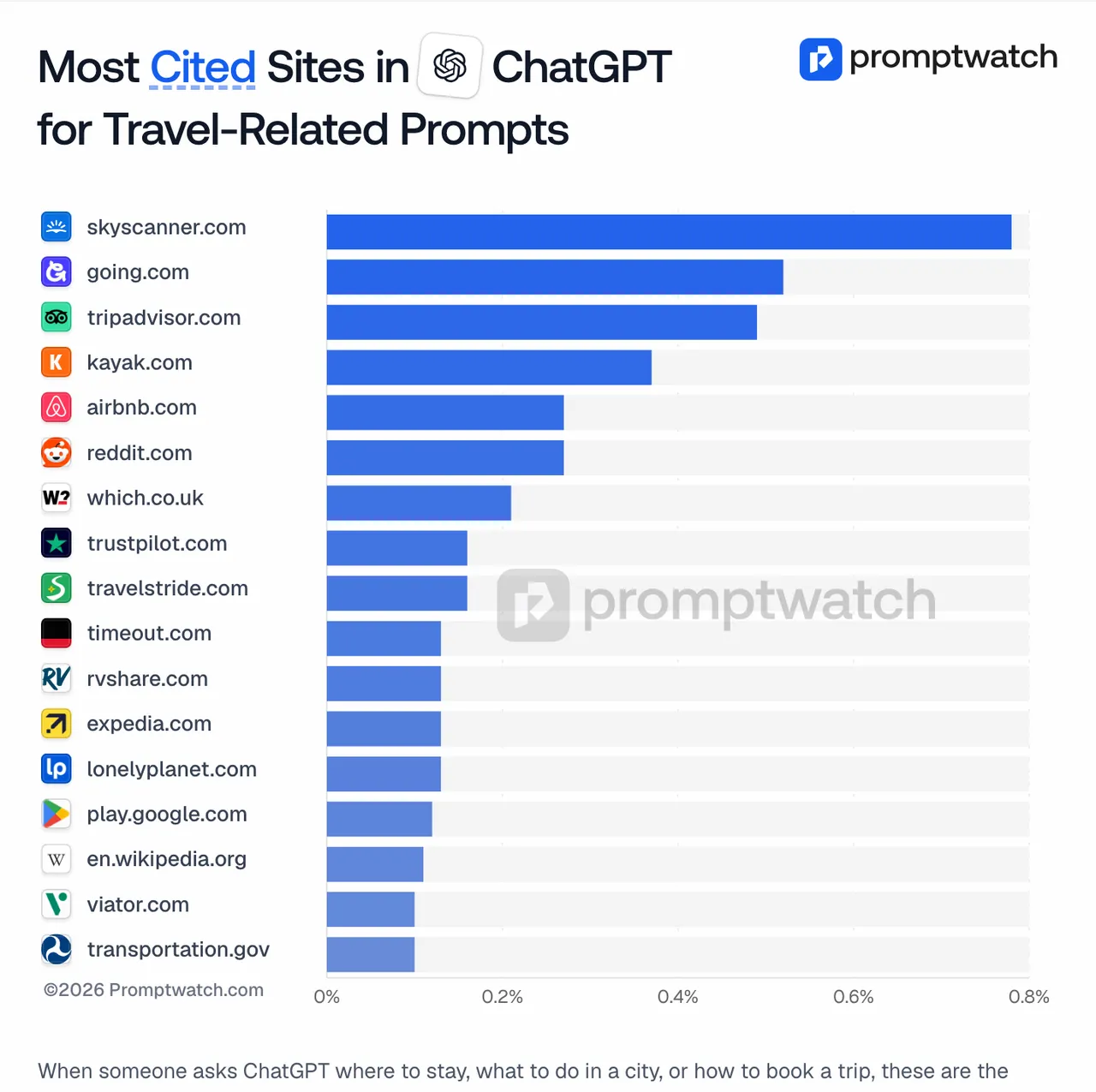 Promptwatch's "Most Cited Sites in ChatGPT for Travel-Related Prompts" chart from the October 2026 travel report, captured November 14, 2026.
Grouped by source type in the same travel report (September 28 to October 4, 2026), booking and search sites take 2.42%, more than half of what the 17 domains hold. Reviews and advice (Tripadvisor, Trustpilot, Which?) take 0.86%. Travel guides and reference come to 0.37%, Reddit 0.27%, tours 0.16%, and transportation.gov 0.1%.
Keep the window in mind. This is one week of data, and the report doesn't claim it holds for other weeks or seasons. Travel demand is seasonal, and we'd expect the mix of prompts to shift with it, though the report doesn't measure that.
What the numbers mean for a travel brand
Our reading has two halves.
The first half is about the head of the list. The most cited single domains are places where travellers compare and book. For a hotel, a tour operator, or a rental company, that means a large part of how ChatGPT talks about you may run through your listing on someone else's site. The booking platform gets the citation; you may or may not get a mention. This is the citation versus mention split Promptwatch's Academy describes, and in travel it's sharper than in most categories.
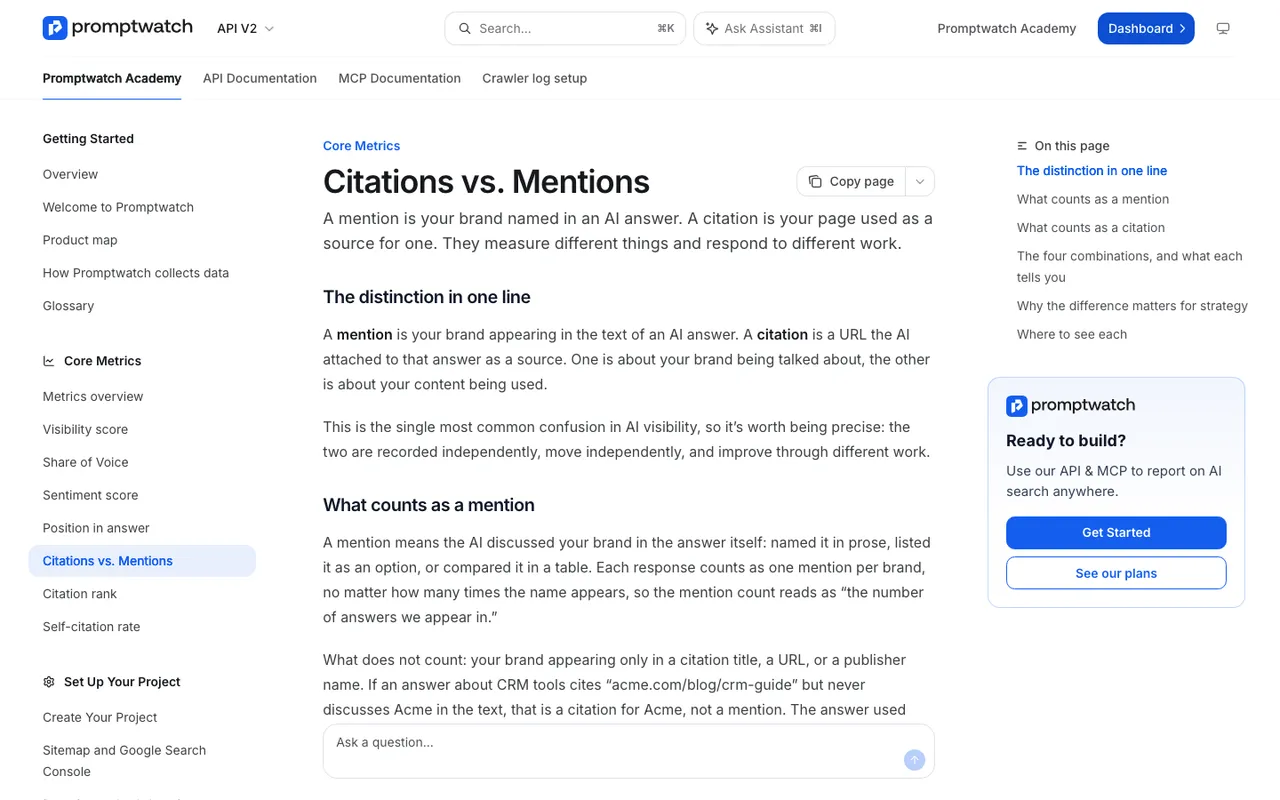 Promptwatch Academy's Citations vs. Mentions page, captured November 14, 2026.
The second half is about the tail. With the top 17 domains holding 4.18% of citations in the report's one-week window (travel report, September 28 to October 4, 2026), no site owns travel answers in ChatGPT. Our read is that ChatGPT draws on a very wide set of pages for travel, including local guides, smaller operators, regional tourism sites, and individual blogs. That is where an independent hotel or a niche tour company has a real shot. A well-built page about a specific experience in a specific place doesn't need to beat Skyscanner. It needs to be the best answer for that particular question.
Neither half says why ChatGPT chose these sources. The report doesn't either. We plan around where citations landed and test against the client's own prompts.
How we split travel client work
We run travel programs across four streams. The weight of each depends on the client's business model, but all four usually appear.
SEO and destination content
This is the stream that targets the long tail. For a destination or experience provider, we build pages around the questions travellers actually ask: what to do in a place in a given season, how to get between two points, what an experience includes, who it suits. Each page answers its question in the first lines, then adds the specifics that make it citable: prices or price ranges the client can stand behind, durations, what's included, accessibility, cancellation terms.
Classic SEO work supports all of it. Crawlable pages, clear headings, internal links between related experiences, structured data where it applies. A page that Google can't parse well is unlikely to be the one ChatGPT picks up either.
Listings on booking and meta-search sites
Booking and search sites hold the largest share in the report, so we audit the client's listings where they exist. Accurate names, descriptions that match the client's own site, current photos, correct amenities and policies. Mismatches between a listing and the brand site create conflicting facts, and we'd rather an AI answer pull consistent details from every source.
For clients who depend on OTAs commercially, this is also a business conversation. We don't recommend pulling off platforms for AI visibility reasons. The listings are part of how travellers, and AI answers, find you.
Review profiles
Reviews and advice sites took 0.86% of travel citations in the travel report (September 28 to October 4, 2026). We set up a steady review request flow after stays or tours and reply to reviews on the platforms that matter for the client. The report names Tripadvisor, Trustpilot, and Which?. We check which review sites ChatGPT actually cites for the client's prompts before deciding where to push.
Community and PR
Reddit tied Airbnb at 0.27% in the same week (travel report, September 28 to October 4, 2026). We don't plan promotional posting. When the client has real expertise, answering travellers' questions in relevant communities can help, and coverage in travel guides and publications feeds the guides and reference category. This is the digital PR side of our work, and we judge it by the same test: does it show up in the sources cited for the client's prompts?
Travel brands we work with usually ask which tracking setup suits them. We covered that in the LLM tracking tool post for travel and hospitality brands.
How we measure it
We run travel programs on Promptwatch, the platform we use for all client programs. Here is the measurement routine.
We start by building prompt sets by market. Travel questions differ by origin country and language, so we create monitors per market. A monitor's language and location are fixed once created, so we plan this upfront: one monitor for English-speaking UK travellers, another for German-speaking travellers, and so on. Monitoring works in any language from any country, and country-level tracking is on every paid plan.
Next we read the competitor views. Share of Voice shows how often the client is named against the competitors we track, and Position shows where in the answer they appear. The heatmap breaks that down by model, topic, or country, which matters in travel, where a brand can be strong in one market and absent in another. Promptwatch's Academy has a playbook on mapping competitors in AI search that follows this order.
Then the sources. The citation analytics show which booking sites, review sites, guides, and pages on the client's own site are cited for each prompt. Citation Trends classifies citations into content and source types, including a Directory type for listing and review sites, so we can see whether the client's answers lean on OTAs, reviews, or the client's own content. Offsite mentions show where the brand is named on third-party pages without a link, which is common in travel.
Finally, Visitor Analytics shows visits from ChatGPT, Perplexity, Gemini, and other AI engines to the client's site, with conversions. That tells us whether citations of the client's own pages lead to bookings, or whether the traffic goes to the OTAs instead.
What we don't promise: that a client will be cited for a given prompt, or that their share will beat a booking platform. We can show which sources ChatGPT uses in their market, fix what the client controls, and track whether the share of answers naming them improves over a full season.
If you run a travel brand and want to see this on your own markets, start the 7-day free trial from Promptwatch's pricing page. The other industry reports, including software and healthcare, are on the Promptwatch data index.