GEO tools for enterprise: how we structure a program next to classic SEO
GEO tools for enterprise, mapped to the steps of a real program: prompt set, crawler access, citations, content, attribution, and Search Console and Bing data next to AI data.
Most conversations about GEO tools for enterprise start with a vendor list. We find it more useful to start with the program and ask which tool does each part of the job. An enterprise already has a working SEO operation: keyword research, a technical backlog, a content calendar, a digital PR team, and a reporting rhythm that the leadership team trusts. GEO has to attach to that operation, not run beside it as a side project with its own vocabulary.
As a full-service agency we run both halves for clients, so we have a fairly fixed structure. It has six workstreams. For each one, this post covers what the work is, what the classic SEO counterpart looks like, and which tool we use. For most of them the answer is Promptwatch, the platform we run client programs on. Where another tool earns its place, we say so.
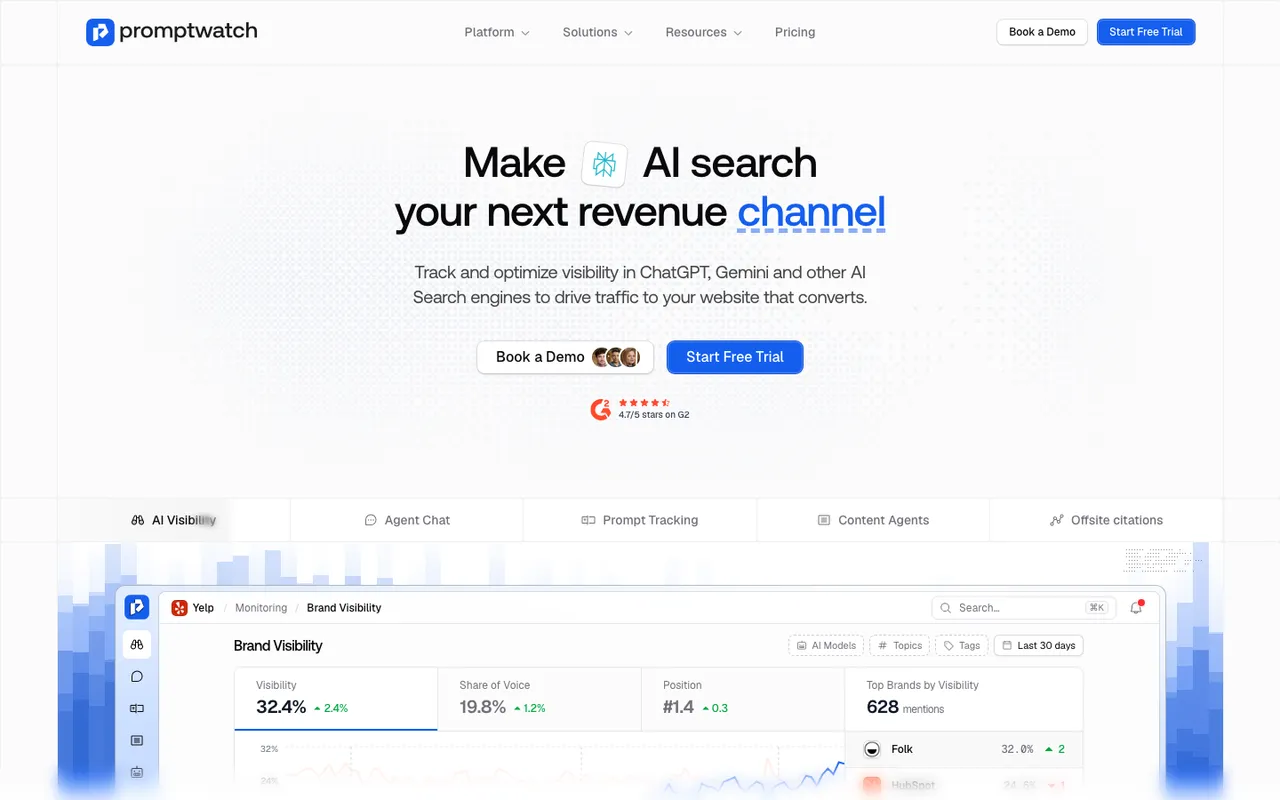 Promptwatch homepage, captured November 6, 2026.
The map at a glance
| Workstream | Classic SEO counterpart | What we use for the GEO side |
|---|---|---|
| Prompt set | Keyword research and rank tracking | Promptwatch monitors, Prompt Volumes, Prompt Explorer |
| Crawler access | Log file analysis, technical audits | Promptwatch Agent Analytics and site audits; Botify where it is already in place |
| Citations | Backlinks and digital PR | Promptwatch citation analytics and offsite mentions |
| Content | Editorial calendar and briefs | Promptwatch Action Board, content gap analysis, Content Agent |
| Attribution | Analytics and conversion tracking | Promptwatch visitor analytics |
| Search data | Search Console and Bing Webmaster Tools | Promptwatch Search Insights, Looker Studio connector |
1. The prompt set
The prompt set is the GEO version of the keyword universe, and it is where enterprise programs go wrong first. Teams either import 2,000 keywords and call them prompts, or they write 30 clever questions that nobody in sales recognizes. We build the set with the business owners: product marketing, sales, support, and the regional teams who know how buyers phrase things in their own market.
In Promptwatch, a monitor is a prompt panel that runs across chosen models, countries, and languages. A monitor's language and location are fixed once it is created, so we design the market structure before entering a single prompt. Prompt Volumes gives monthly volumes, difficulty scores, and citation rates across AI search, Google, and Bing, which lets us prioritize the way an SEO team prioritizes keywords. Prompt Explorer suggests prompts from Search Console queries, ranking keywords, People Also Ask, or any page on the site, which is the cleanest bridge between the existing keyword research and the new prompt set.
Each prompt gets a type (organic, brand specific, competitor comparison), an intent, topics, and tags. Personas let us ask the same question as a procurement lead and as an engineer, and the Persona Insights radar shows where they diverge. Country-level tracking is on every paid plan. State and city tracking starts on Business, which matters for enterprises with regional sales or physical locations. The Brand Book holds the instructions that decide what counts as a mention, so a subsidiary brand or a product line name is counted consistently across markets.
2. Crawler access
Classic SEO teams already read server logs for Googlebot. The GEO equivalent asks a different question: are AI systems fetching the pages we want cited, and are they getting a clean response?
Promptwatch's Agent Analytics reads AI crawler logs in real time and verifies each hit against the operator's published IP ranges, so spoofed user agents are filtered out. It tracks bots such as GPTBot, OAI-SearchBot, ChatGPT-User, ClaudeBot, PerplexityBot, and Meta-WebIndexer, and it shows a crawl-to-citation path with a citation rate per page. That one metric separates an access problem (the page is never fetched) from a content problem (it is fetched often and never cited). Since November 4, 2026, search indexers such as OAI-SearchBot count as AI crawls, while citation crawls are only bots that fetch a page while answering a user, like ChatGPT-User. If you compare periods across that date, expect the category totals to shift.
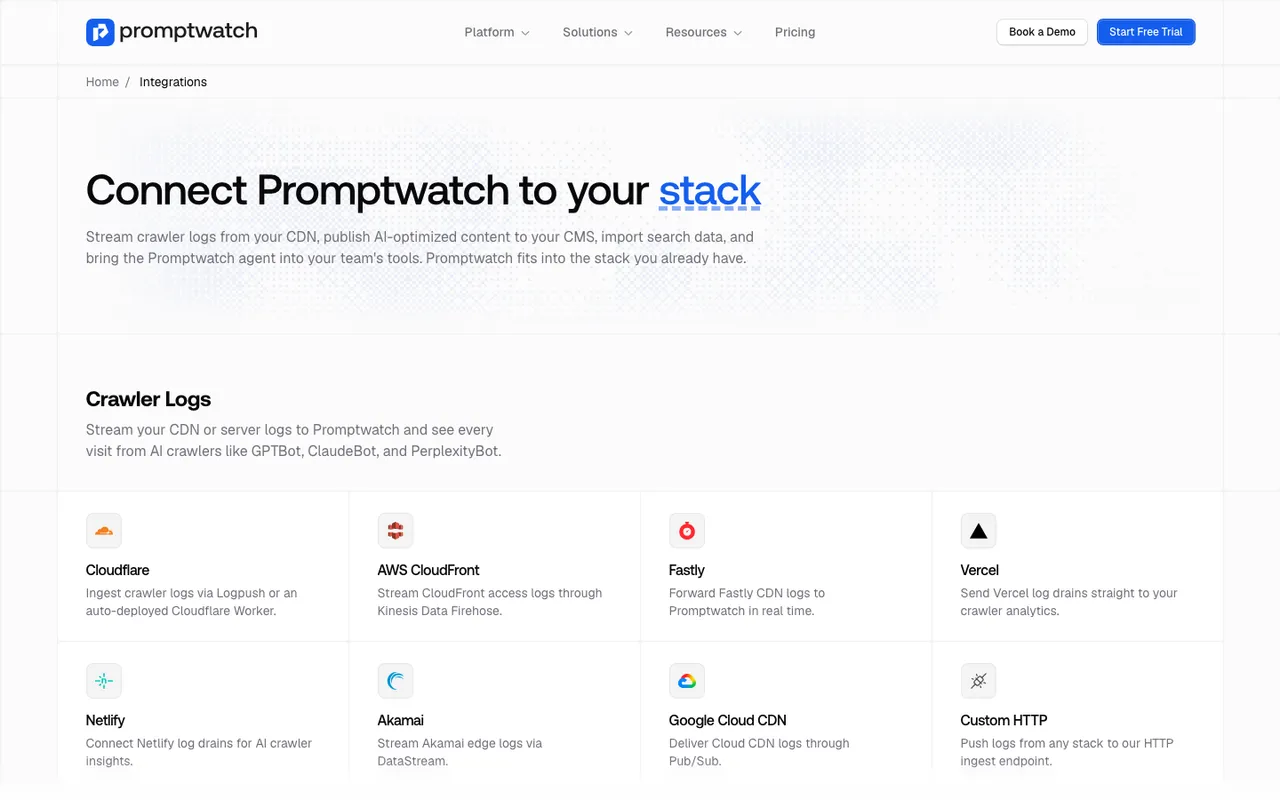 Promptwatch integrations page, captured November 6, 2026.
The connection is an engineering ticket, not a marketing task. Enterprise sites usually sit behind Cloudflare, CloudFront, Fastly, or Akamai, and Promptwatch ingests logs from all of them, plus Vercel, Netlify, Google Cloud CDN, a custom HTTP endpoint, or a WordPress plugin. Crawler logs start on the Professional plan. Weekly site audits run 21 checks and flag broken links, orphaned pages, and pages missing from the sitemap, which overlaps with the technical SEO backlog in a useful way: one ticket often fixes both.
Where a client already runs Botify, we keep it. Botify's own homepage describes serving content to agents in under 300ms, rebuilding product feeds for Google and OpenAI, and a dataset of more than 1,000 metrics across traditional and AI search. That is delivery infrastructure for very large sites, and it does a different job from prompt-level tracking. It publishes no prices.
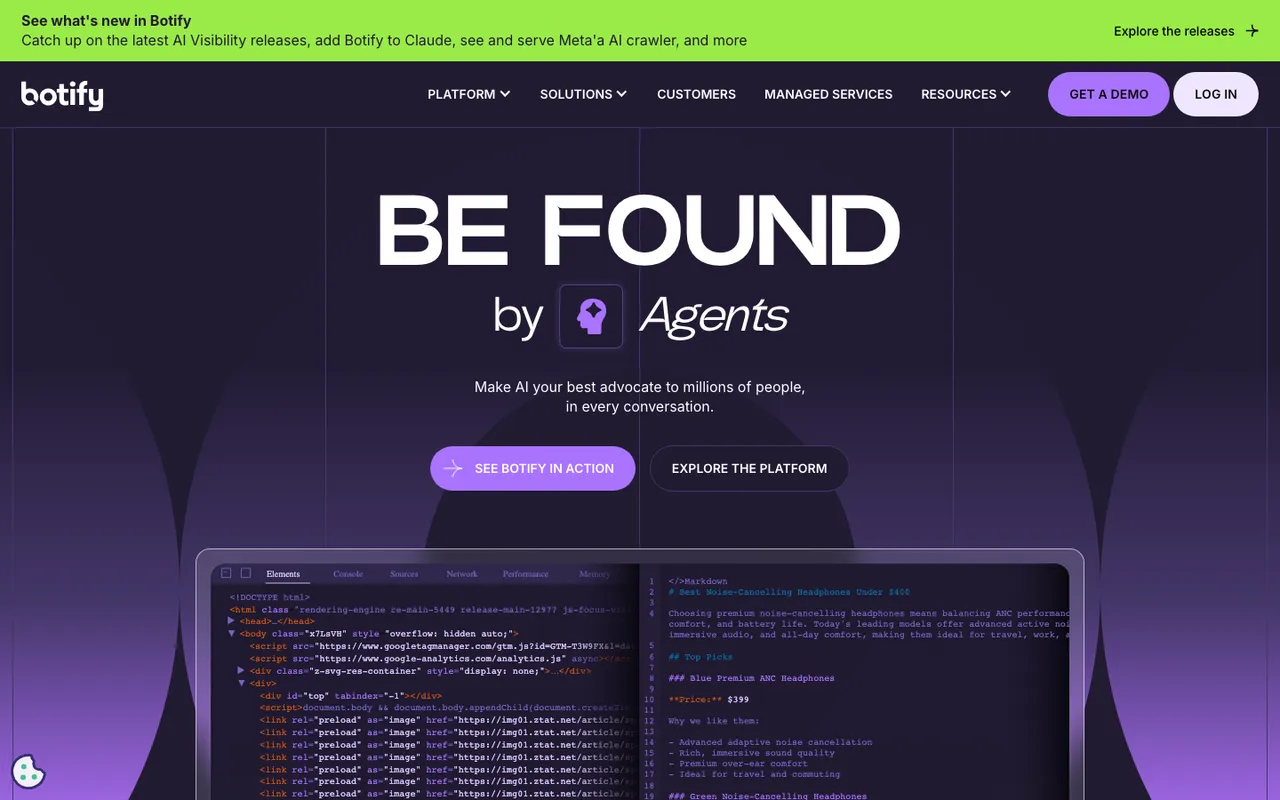 Botify homepage, captured November 6, 2026.
3. Citations
In classic SEO, the off-page work is links and digital PR. In GEO it is citations: which URLs the engines quote when they answer, and whose they are. This workstream decides how much of the budget goes to owned content and how much to earned media, so it needs real data rather than instinct.
Promptwatch's citation analytics show cited URLs and domains with competitor domains highlighted. Citation Trends classifies each citation into 22 content types and 20 source types, including a Directory type for review and listing sites, and tracks when a page was first cited, how fast it ramped up, and how quickly citations decay. Separate reports cover Reddit, YouTube, LinkedIn, and Instagram, and offsite mentions list third-party pages that name the brand without linking.
Two findings from Promptwatch's data reports shaped how we brief PR teams this year. Reddit's share of ChatGPT citations fell from about 4% to about 0.5% on August 14, 2026, so a Reddit-heavy plan written in spring needed a rethink. And in August 2026, mid-authority domains (DR 46 to 75) earned almost half of ChatGPT citations while DR 91 to 100 earned about 3%. For an enterprise PR team that habitually chases only the biggest publications, that second number changes the target list.
4. Content
Content is where GEO and SEO compete for the same writers, so we run one calendar, not two. The GEO items enter it through Promptwatch's Action Board, a prioritized list covering content gaps, sentiment, Reddit, offsite mentions, site health, and untapped pages. A Discovery agent investigates on a weekly schedule and proposes up to five evidence-backed actions per run. Items carry assignees and comments, which suits an enterprise where the person who reads the report is rarely the person who edits the page.
Content gap analysis with coverage scores is on every plan. Content Refresh suggests diff-style updates to existing pages, which is often the cheaper win on a large site. On Business and Enterprise, the Content Agent plans, writes, and publishes against visibility gaps on a schedule, with a review inbox where editors approve, edit, or decline. It picks internal links before writing and favors pages with many Search Console impressions but few clicks, which is a classic SEO instinct built into the GEO workflow. Publishing goes to WordPress, Webflow, or Framer. On enterprise accounts we keep every draft in the review inbox; legal and brand teams expect that.
Many enterprises already run an editorial suite. Conductor is the one we meet most often. Its pricing page publishes tiers without prices: Essentials with 500 tracked keywords and 60 writing assistant drafts a year, Growth with 5,000 keywords and 2,500 AI search credits a year, and a contact-sales Enterprise tier. If the client's writers live in Conductor, the GEO briefs can live there too. What we still need from Promptwatch is the evidence behind each brief: the prompt, the cited competitor URL, and the crawl data for the page we want to win.
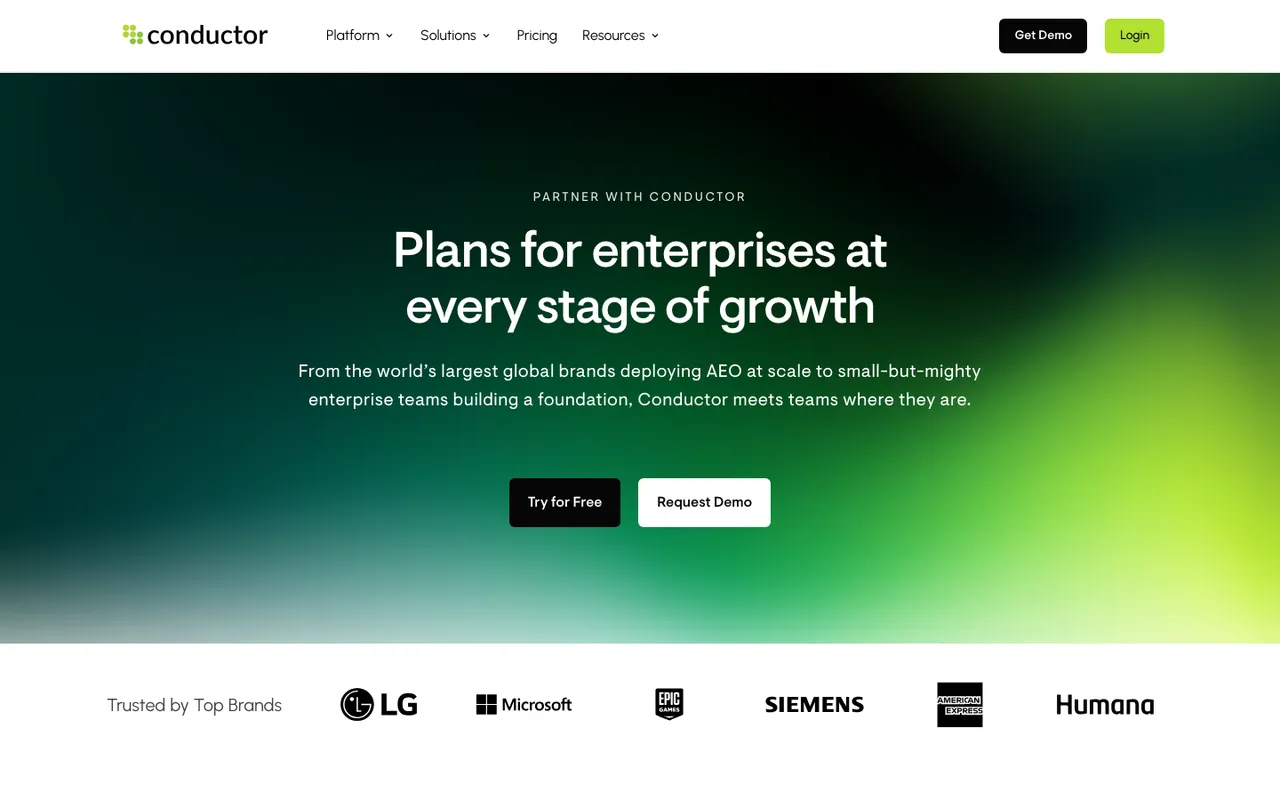 Conductor pricing page, captured November 6, 2026.
5. Attribution
Leadership eventually asks whether any of this produces revenue. Promptwatch's visitor analytics track AI-referred visits and conversions from ChatGPT, Perplexity, Gemini, Claude, Copilot, DeepSeek, and others, installed through a lightweight script, a GTM template, or the WordPress plugin. One wrinkle to brief the analytics team on: ChatGPT stopped sending a referrer on October 8, 2026, and the "Include ChatGPT UTM referrers" toggle counts utm_source=chatgpt.com visits as ChatGPT again without double counting.
Promptwatch's published case studies give a sense of what attribution can show, and we cite them as the customers' results, not as a forecast. Crisp found AI-referred traffic converted at twice the rate of its traditional channels. For TreeHouse (Pararius, Huurwoningen.nl), AI search became about 25% of organic conversions, 99% of it from ChatGPT, after fixing crawler access and publishing proprietary rental data.
6. Search Console and Bing next to AI data
The last workstream is reporting, and it is the one that makes GEO stick inside an enterprise. Search Insights, part of Promptwatch's 360 Insights on the brand plans and Enterprise, overlays Google Search Console and Bing Webmaster clicks and impressions (including Microsoft Copilot) on AI crawls, citations, and clicks per page and per topic. A page that lost Google clicks and ChatGPT citations in the same month is a different problem from one that lost only one of them, and this is the view that shows it.
For the executive report we pipe the data into the client's own dashboards through the Looker Studio connector (Professional and up) or the REST API, which accepts date ranges up to 92 days. That way, AI search becomes a section of the existing search report, with the same owners and the same meeting.
Cadence and governance
We run a weekly triage of the Action Board and crawler errors, a monthly report that combines search and AI data, and a quarterly review of the prompt set, because buyer questions drift. Tracking runs daily by default; Business adds 12, 6, or 1 hour frequencies, which we reserve for launches and crises because they cost responses. Owners, editors, and viewers keep access tidy, and the audit log on Business and Enterprise records whether a change came from a person, the API, an MCP client, or Agent Chat. Our 90-day GEO program covers the first quarter in more detail.
Where to start
Before any of this, get a baseline. Promptwatch's free AI Visibility Report scans a site against ChatGPT, Gemini, and Perplexity and checks crawler access in a couple of minutes, without a login. It is a fair way to see where an enterprise brand stands before the program has a budget line.
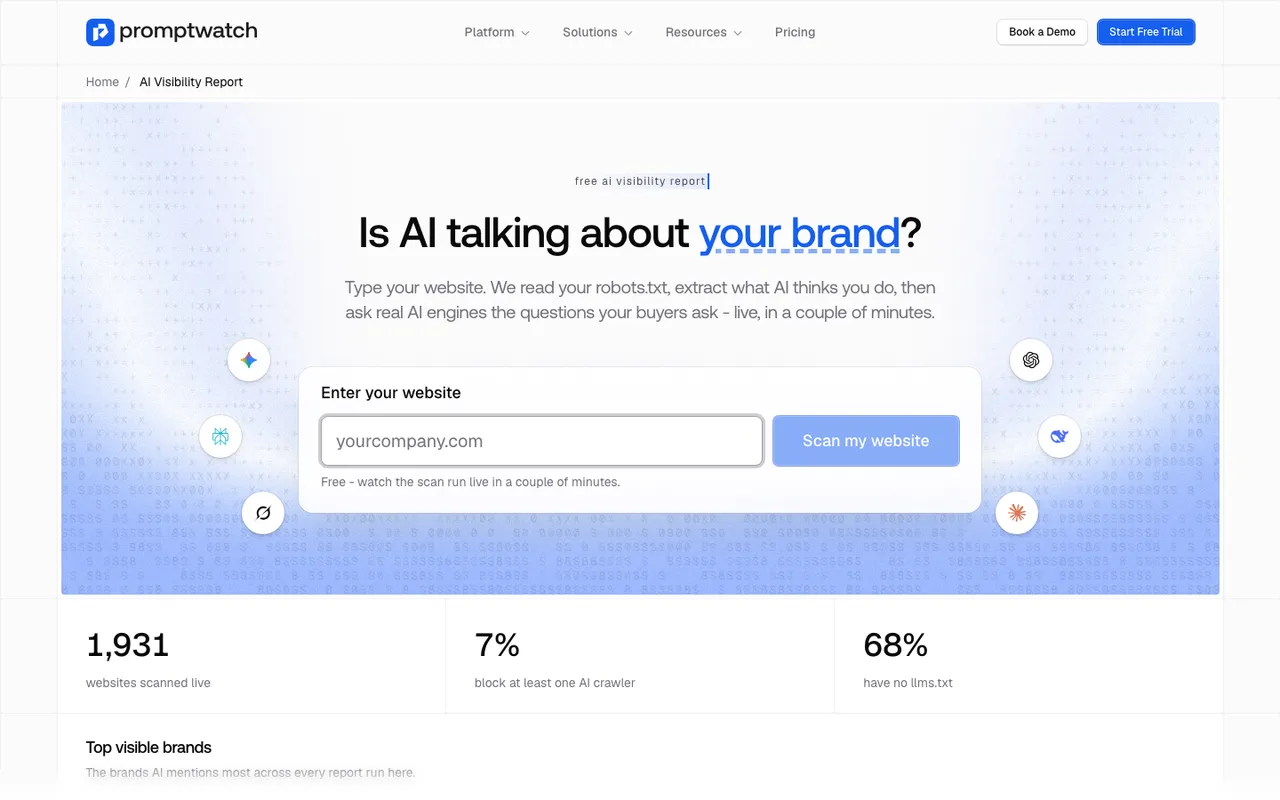 Promptwatch free AI Visibility Report, captured November 6, 2026.
Run the free AI Visibility Report on your main domain and bring the result to your next SEO planning meeting. If you would like us to build the program around it, write to hello@1001seomedia.com.